A Beginner’s guide to exercise for health optimization
TL;DR
Core Concept: Exercise for health optimization is not about specializing in one activity. The healthiest approach combines five complementary pillars: Strength, Zone 2 Cardio, High-Intensity Cardio, Mobility, and Balance..
Significance: A recent study following more than 111,000 participants over 30 years found that people who engaged in a wider variety of physical activities had significantly lower mortality rates than those who focused on fewer activities. Variety itself appears to be a longevity advantage.[3]
Challenges: Most people know what the ideal exercise plan looks like, but struggle to implement it. Rather than trying to improve all five pillars simultaneously, use the Cycling Principle: focus on one pillar at a time, build the habit, maintain it, then shift your focus to the next pillar.
Implementation Tips – Practical Guidelines (Shared below!) (Scroll down in the full article!)
OVERVIEW
Welcome to the a beginner’s guide to exercise for health optimization!
Most people know that regular physical activity is good for them, but when they decide to start, they often get stuck in a sea of overwhelming misinformation.
The opportunity here is massive: regular exercise can reduce your risk of all-cause mortality by 22%.[1]
If you adopt a balanced, well-rounded approach to fitness, the ideal outcome is not just looking good for the summer, but building a body that carries you forward for decades to come. The ultimate vision is to optimize your health today so you can stay strong, resilient, and injury-free tomorrow,.
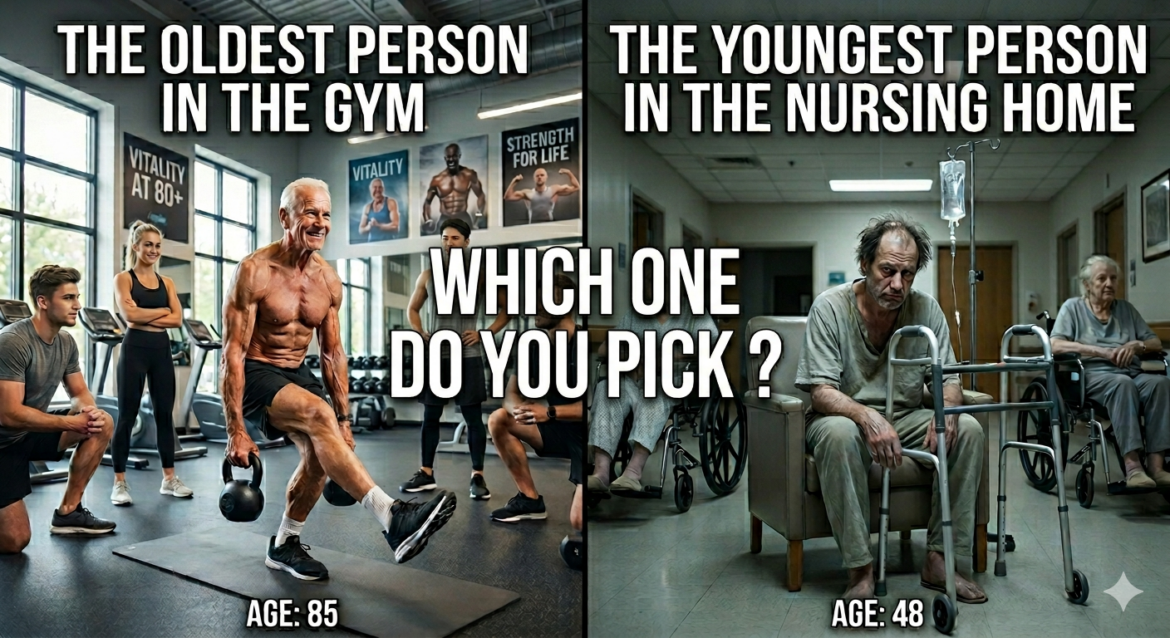
“Ultimately, you want to be the oldest person in the gym, rather than the youngest person in the nursing home.” B.JOHNSON
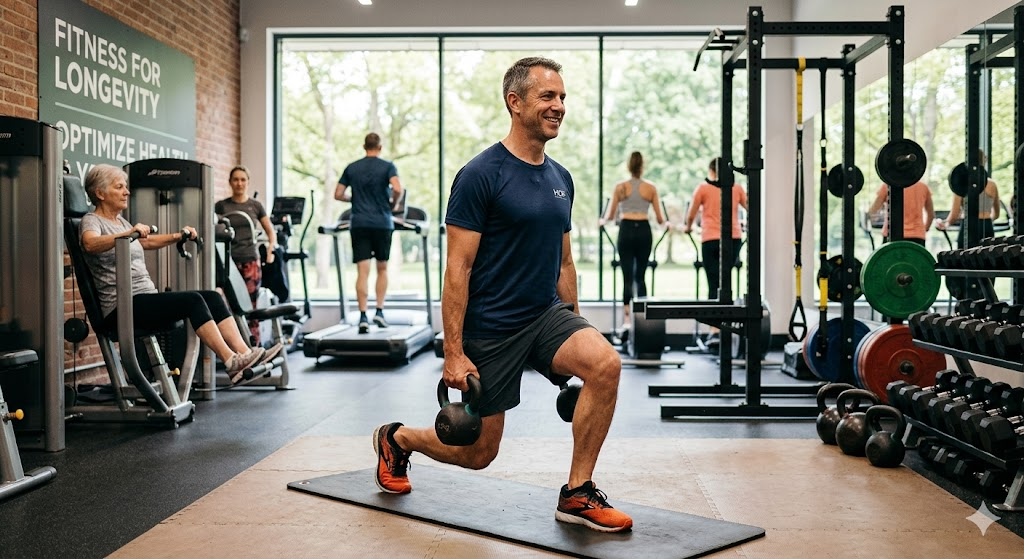
What Is Exercise for Health Optimization?
When most people think about exercise, they usually focus on a single goal:
losing weight, building muscle, running faster, or improving athletic performance.
But health optimization requires a broader perspective.
Your body is not one system—it is a collection of interconnected systems. Your muscles, cardiovascular system, metabolism, joints, nervous system, and brain all influence one another. Neglecting one area long enough eventually affects the others.
The goal of exercise for health optimization is therefore not to become exceptional in one domain. It is to maintain enough strength, endurance, mobility, balance, and resilience to remain functional, independent, and healthy for as long as possible.
The 5 Pillars of Exercise for Health Optimization
A complete exercise program can be broken down into five foundational pillars.
Pillar 1: Strength Training
Strength training builds muscle mass, improves bone density, enhances insulin sensitivity, and protects against age-related decline.
Examples include:
- Squats
- Deadlifts
- Push-ups
- Pull-ups
- Resistance bands
- Weight training
The objective is simple: progressively challenge your muscles over time through increased resistance, repetitions, or training volume.
Pillar 2: Zone 2 Cardio
Zone 2 refers to low-intensity cardiovascular exercise performed at an effort where you can still comfortably hold a conversation.
Examples include:
- Cycling
- Light jogging
- Hiking
- Rowing
Zone 2 training improves mitochondrial function, metabolic flexibility, fat oxidation, and aerobic capacity. It builds the engine that supports all higher-intensity activities.
Pillar 3: High-Intensity Cardio
High-intensity exercise develops cardiovascular power, VO₂ max, and resilience under stress.
Examples include:
- Sprint intervals
- Hill repeats
- Rowing intervals
- Norwegian 4×4 training
While Zone 2 builds the aerobic base, high-intensity training expands your performance ceiling.
Pillar 4: Mobility and Flexibility
As we age, joints become stiffer, connective tissues lose elasticity, and movement quality deteriorates.
Mobility training helps preserve:
- Hip function
- Shoulder mobility
- Spinal movement
- Ankle flexibility
- Overall movement quality
The goal is not simply to stretch, but to maintain the ability to move efficiently and pain-free throughout life.
Pillar 5: Balance and Coordination
Balance is one of the most overlooked components of fitness.
Examples include:
- Single-leg stands
- Eyes-closed balance drills
- Stability exercises
- Dynamic coordination work
Balance reflects the health of your nervous system and plays a critical role in fall prevention, longevity, and maintaining independence later in life.
What Most People Get Wrong
The modern fitness world often pushes people toward extremes. Some people only lift weights.
Others only run. Others focus exclusively on flexibility, mobility, or endurance.
The problem is that health optimization is not about specializing—it is about diversification.
Many people avoid certain forms of exercise because of outdated myths [2]:
- “Lifting weights makes you inflexible.”
- “Cardio kills muscle gains.”
- “Walking doesn’t count.”
- “Stretching is a waste of time.”
- “Balance exercises are only for older people.”
None of these statements are supported by the scientific literature.
The New Science of Exercise Variety
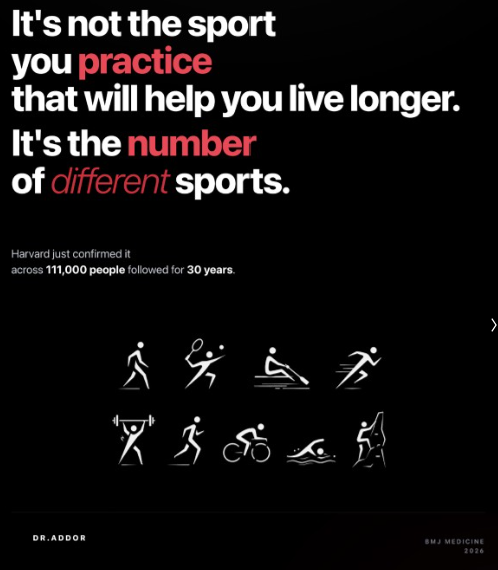
One of the most important findings in exercise science comes from a recent BMJ Medicine study that followed more than 111,000 participants over three decades [3]. Researchers examined not only how much people exercised, but also how many different types of physical activities they consistently practiced.
The results were striking.
People who engaged in a wider variety of physical activities experienced lower mortality rates, even after researchers accounted for total exercise volume.
Those with the highest activity variety had a 19% lower risk of all-cause mortality compared with those who performed the least variety of activities.
Benefits were also observed for cardiovascular disease, cancer, respiratory disease, and other causes of death.
In other words: Doing different kinds of exercise may be nearly as important as doing more exercise.
The researchers concluded that different forms of movement likely provide complementary physiological benefits. Aerobic exercise improves cardiovascular fitness. Resistance training improves strength and muscle mass. Mobility work preserves movement quality. Balance training supports neurological function and fall prevention. Together, these systems create a stronger and more resilient human being.
This finding strongly supports a multi-pillar approach to health optimization.
The Most important Takeaway
You do not need the perfect exercise routine. You do not need to become an elite athlete.
You simply need to move consistently and develop all the major systems that keep you healthy.
Build strength. Develop your aerobic engine. Challenge your cardiovascular capacity.
Maintain mobility. Preserve balance.
Most importantly, avoid putting all your fitness efforts into a single bucket.
The latest science suggests that longevity may not belong to those who specialize in one form of exercise, but to those who maintain a diverse movement portfolio throughout life.
Your body was designed to do many things. It would be better to train accordingly…
And I will share with you below, some practical guidelines to help you to do so.
INTERESTING VIDEOS TO WATCH
HOW TO GET INTO HACKTION?

Practical Instructions – Exercising for longevity
The mission is simple:
Use mouvement and exercise as medical prescription to be in the best metabolic and cognitive health you can!
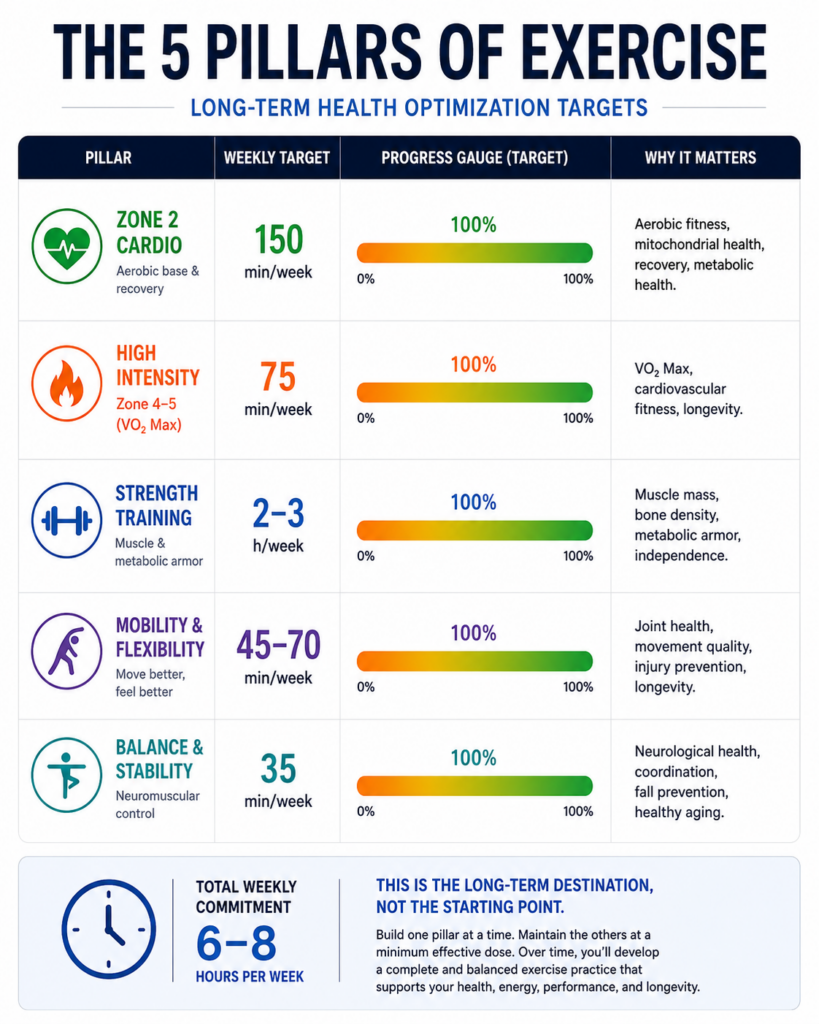
Long-Term Health Optimization Targets
HOW TO GET THERE ? [Some wisdom to share…]
The Missing Piece: How Do You Actually Get There?
Most health and fitness recommendations focus on the end destination.
Science tells us that the ideal exercise routine includes strength training, Zone 2 cardio, high-intensity intervals, mobility work, and balance practice. On paper, it makes perfect sense.
But there is one problem: Most people are already busy, tired, and overwhelmed.
If implementing all five pillars were easy, most of us would already be doing it.
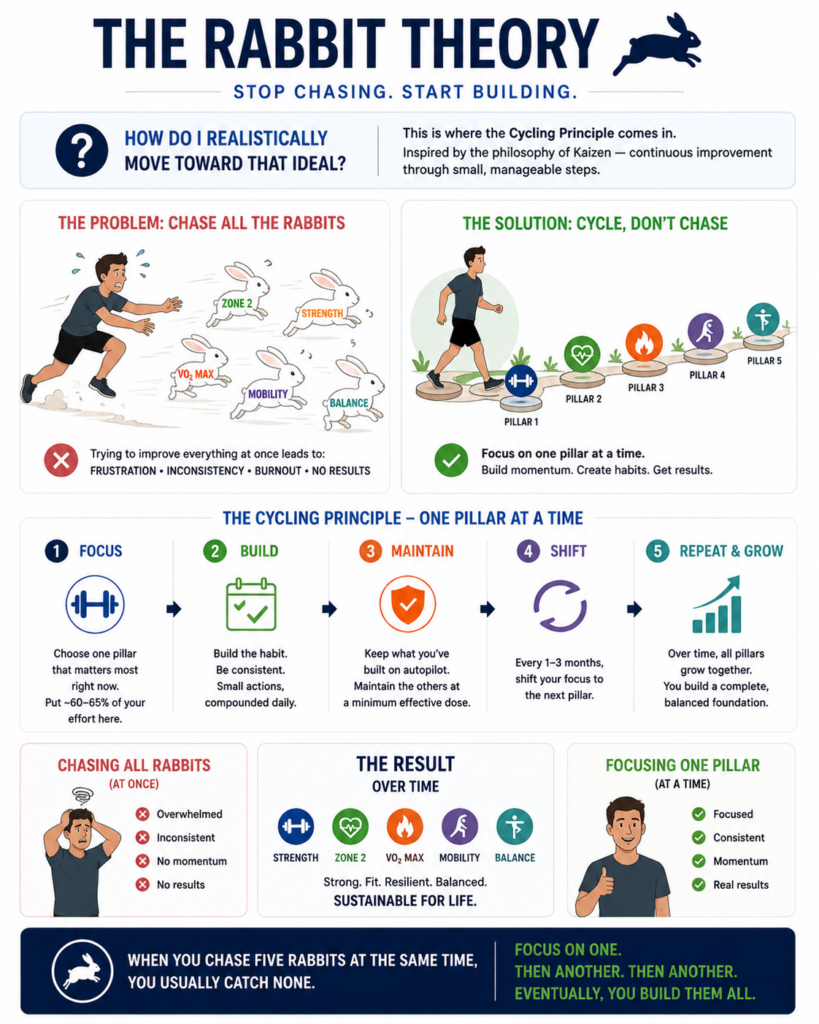
So we need to shift from : “What is the ideal plan?”
To “How do I realistically move toward that ideal?”
This is where the Cycling Principle comes in along the philosophy of Kaizen — continuous improvement through small, manageable steps — the goal is not to chase every pillar at once. Trying to improve everything simultaneously often leads to frustration, inconsistency, and eventually doing nothing at all.
Instead, focus your energy on one pillar at a time. Build momentum.
Create a habit. Maintain what you’ve built. Then shift your focus to the next pillar.
Over time, these small wins accumulate into a complete and sustainable exercise practice.
Because when you chase five rabbits at the same time, you usually catch none.
When you focus on one, then another, then another, you eventually build them all.
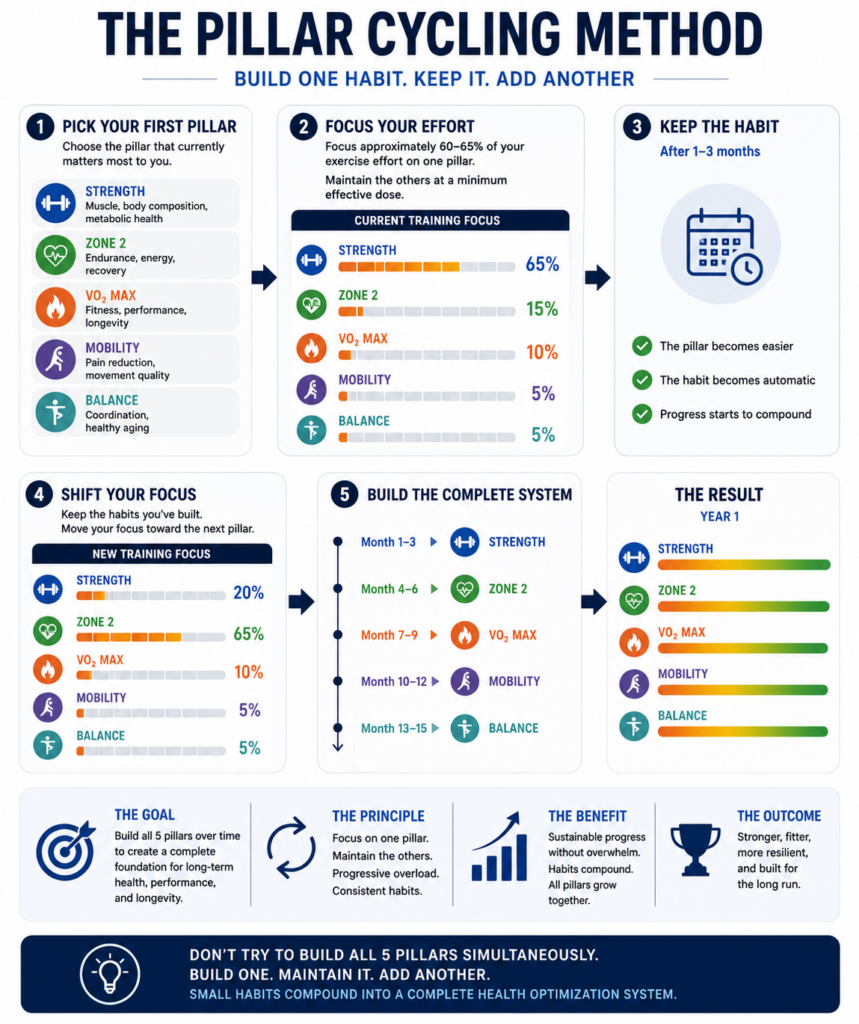
Phase 1: Pick One Pillar
Choose the pillar that currently matters most to you.
Examples:
💪 Strength
❤️ Zone 2
🔥 VO₂ Max
🤸 Mobility
⚖️ Balance
Focus approximately 60–70% of your exercise effort on this pillar.
Maintain the others at a minimum effective dose.
Phase 2: Pillar Cycling
Every 1–3 months:
➡️ Keep the habits you’ve built
➡️ Shift your focus to another pillar
Over time, all pillars grow together.
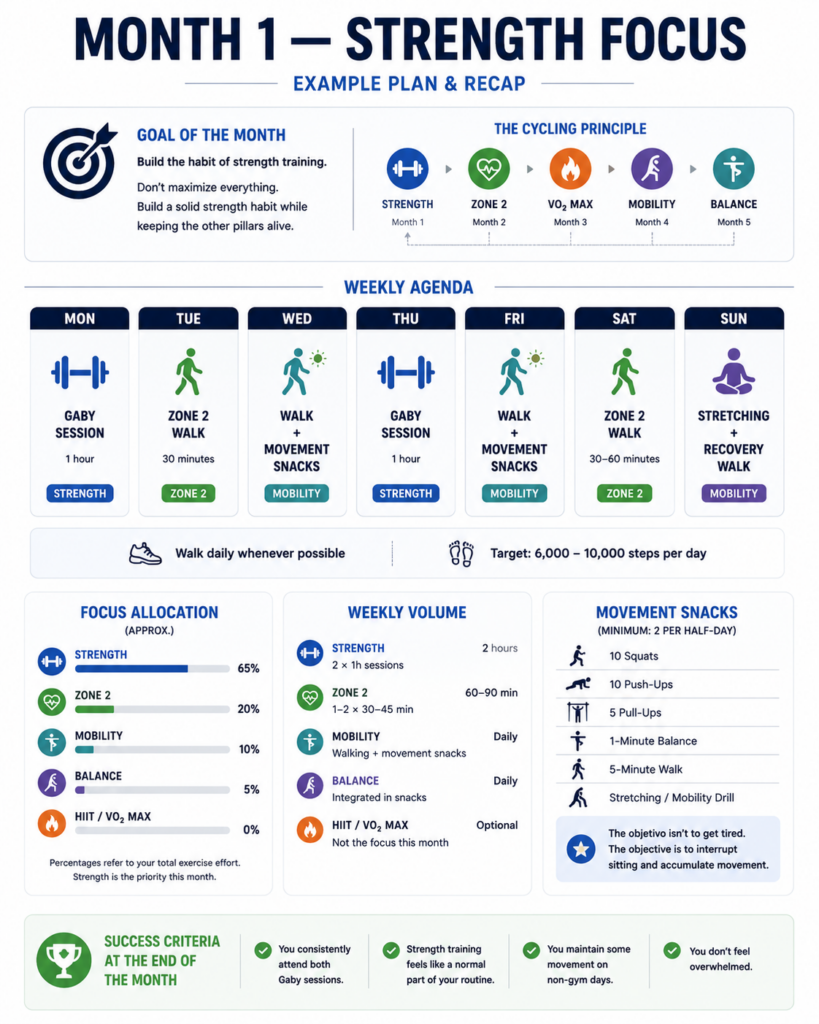
A WEEKLY EXAMPLE FOR ALEA’S TEAM
Knowing that :
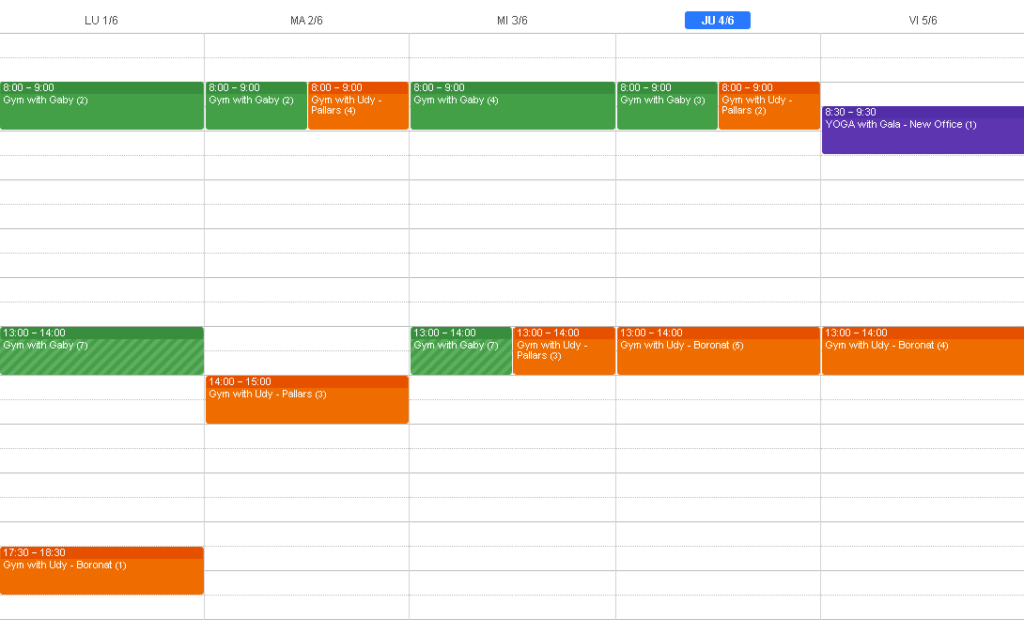
💪 Gaby → Strength
🔥 Udy → High Intensity
🤸Gala (Yoga) → Mobility & Flexibility
Autonomy (fitness zone/treadmill or bike) → Zone 2
Let’s say you wanna focus first on strenght, and you can only train 2-3h a week. Here is a possible way of doing things :
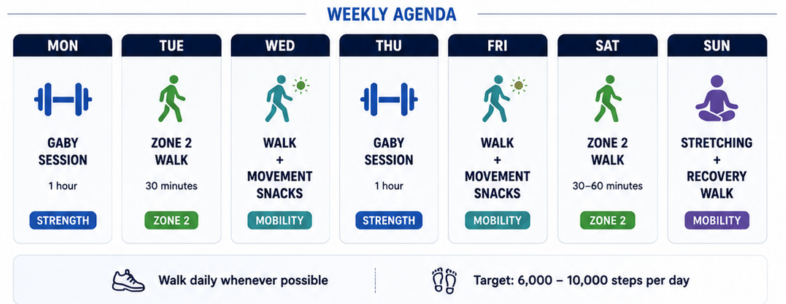
Full recap of the training approach :
The Secret Weapon : Exercise Snacks
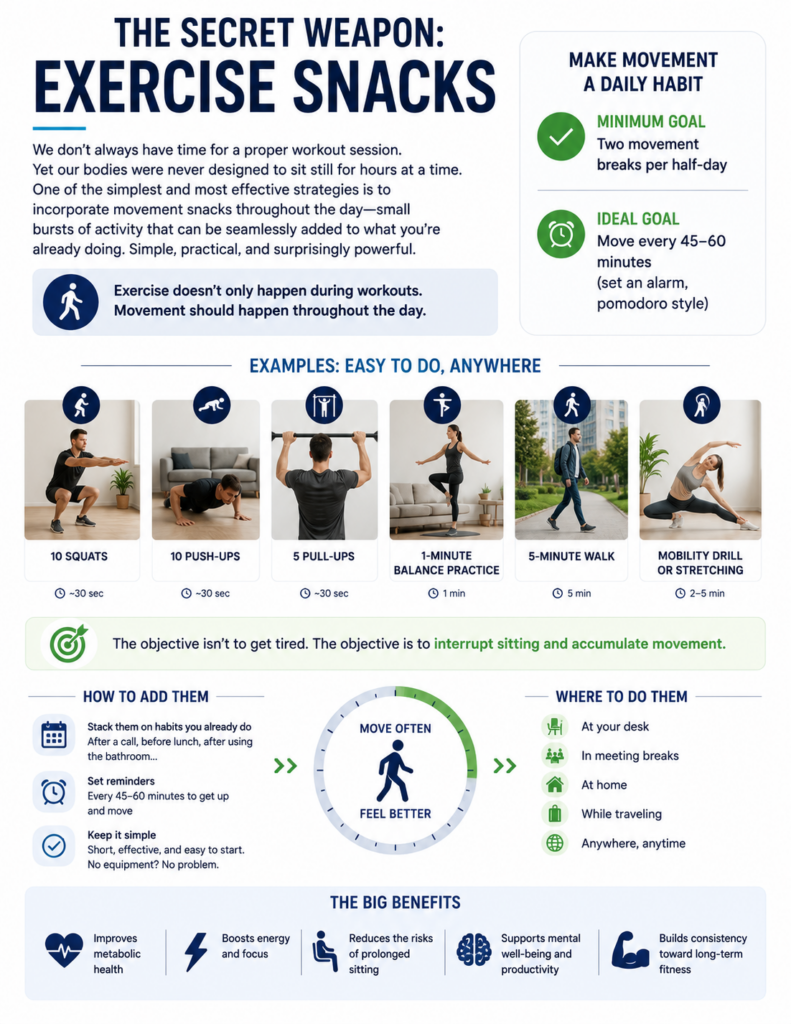
We don’t always have time for a proper workout session. Yet our bodies were never designed to sit still for hours at a time. One of the simplest and most effective strategies is to incorporate exercise snacks throughout the day—small bursts of activity that can be seamlessly added to what you’re already doing. Simple, practical, and surprisingly powerful.
Exercise doesn’t only happen during workouts. Movement should happen throughout the day.
Minimum Goal
✅ Two movement breaks per half-day
Ideal Goal
✅ Move every 45–60 minutes (set an alarm, pomodoro style)
Examples:
- 10 squats
- 10 push-ups
- 5 pull-ups
- 1-minute balance practice
- 5-minute walk
- Mobility drill
- Stretching
The objective isn’t to get tired. The objective is to interrupt sitting and accumulate movement.
AUTHOR’S NOTE
If I had to summarize this entire article in just a few words, it would be:
Just move. Move, move, and move again.
Whether it’s walking, lifting weights, cycling, yoga, tennis, paddle, ping-pong, dancing, swimming, or any activity you genuinely enjoy, the most important thing is to get your body back into motion.
Personally, I believe movement works best when it’s fueled by curiosity, enjoyment, and a sense of play rather than obligation. The recommendations shared in this article provide a framework, not a prison. Use them as a guide, but feel free to adapt them to your own preferences, goals, and lifestyle.
Once you’re moving consistently, everything else becomes easier. We can then build a plan, define meaningful goals, and progressively develop the five pillars that science associates with better health, greater resilience, and a longer healthspan.
So don’t overthink it. Pick an activity you enjoy.
Move today. And then do it again tomorrow.
CONCLUSION
Your body was designed to move in many different ways, not to specialize in just one.
Start small, build one pillar at a time, and trust the compounding effect of consistent movement.
The goal isn’t to become a better athlete—it’s to become a healthier, stronger, and more resilient human being for life.
With much care, Erwin 🙂
F.A.Q
Do I need to train all five pillars every week?
Ideally, yes. The healthiest exercise programs include some combination of strength, cardiovascular fitness, mobility, and balance.
However, this doesn’t mean you need to master all five pillars immediately.
For many people, the best approach is to focus primarily on one pillar for several weeks or months while maintaining the others at a minimum effective dose. Once that habit is established, shift your focus to another pillar while preserving the gains you’ve already built.
Think of it as building a house one room at a time rather than trying to finish the entire structure at once.
What if I don’t have time to exercise 6–8 hours per week?
Most people don’t start there.
The weekly blueprint represents an ideal destination, not a starting point.
If you’re short on time, begin with the smallest possible action:
- A 10-minute walk after meals
- Two exercise snacks per day
- One strength session per week
- Five minutes of mobility before bed
Consistency beats perfection.
A routine you can sustain for years will always outperform an ambitious plan that lasts two weeks.
How Which pillar should I focus on first?
There is no universal answer.
Your first pillar should address your biggest weakness or your most important goal.
Examples:
- Want to improve energy and endurance? → Start with Zone 2.
- Want to build muscle and resilience? → Start with Strength.
- Want to reduce pain and stiffness? → Start with Mobility.
- Want to improve athletic performance? → Add HIIT.
- Want to age well and reduce fall risk? → Practice Balance.
The best pillar is the one you’re most likely to practice consistently.
Are exercise snacks really effective?
Yes.
Exercise snacks are short movement breaks performed throughout the day.
Examples include:
- 10 squats
- 10 push-ups
- A short walk
- A mobility drill
- A balance exercise
While they don’t replace structured training, they reduce sedentary time, improve blood sugar control, increase daily movement, and help reinforce healthy habits.
Small actions repeated consistently can have a surprisingly large impact over time.
What’s more important: Zone 2, Strength, or HIIT?
The answer is all three.
Strength training protects muscle mass, bone density, and metabolic health.
Zone 2 develops the aerobic engine that supports long-term endurance and mitochondrial function.
HIIT improves VO₂ max, one of the strongest predictors of longevity and cardiovascular health.
Rather than asking which one is best, the better question is:
“Which one am I currently neglecting?”
Health optimization comes from balancing all the systems that keep you strong, energetic, and functional throughout life.
REFERENCES
[1] Martinez-Gomez D, Luo M, Huang Y, Rodríguez-Artalejo F, Ekelund U, Sotos-Prieto M, et al. Physical activity and all-cause mortality by age in 4 multinational megacohorts. JAMA Netw Open. 2024;7(11):e2446802. doi:10.1001/jamanetworkopen.2024.46802.[1] https://pubmed.ncbi.nlm.nih.gov/39570587/[2]Bryan Johnson, Blue Print Project : https://www.youtube.com/watch?v=JNuORofHhrk[3]Han H, Hu J, Lee DH, Zhang Y, Giovannucci E, Stampfer MJ, et al. Physical activity types, variety, and mortality: results from two prospective cohort studies. BMJ Med. 2025;5(1):e001513. doi:10.1136/bmjmed-2024-001513.https://bmjmedicine.bmj.com/content/bmjmed/5/1/e001513.full.pdf
