
Fitness: Build Your Aerobic Engine to Elevate your HRV
TL;DR
Core Concept: Heart Rate Variability (HRV) reflects how efficiently your body regulates stress and recovery through the balance of the autonomic nervous system. One of the most powerful drivers of HRV is aerobic fitness — particularly the capacity of your cardiovascular system to deliver and utilize oxygen (VO₂ max).
Significance: Improving aerobic capacity enhances your body’s ability to handle stress, recover faster, and maintain stability under load. While VO₂ max and HRV are distinct (structural vs regulatory), increasing VO₂ max often leads to favorable HRV adaptations over time, especially through improved parasympathetic activity.
Challenges: HRV does not improve instantly through exercise. High-intensity training can temporarily decrease HRV due to stress load, and meaningful improvements require consistent training over weeks to months. The key challenge is balancing intensity and recovery to avoid fatigue accumulation.
Implementation Tips – Practical Guidelines (Shared below!) (Scroll down in the full article!)
OVERVIEW
Heart Rate Variability (HRV) is not only a reflection of your nervous system.
It is also deeply influenced by your physical capacity to handle stress.
And one of the most important drivers of HRV is: Aerobic fitness.
This includes:
- VO₂ max
- Cardiac efficiency
- Mitochondrial function
- Oxygen delivery and utilization
From a physiological perspective, HRV improves when the body becomes more efficient at regulating internal stress.
And this efficiency is largely shaped by how well your cardiovascular system performs.

Block-Based Strategy : Why an Exercise Block Matters
Unlike breathwork, which directly targets the nervous system…Exercise works at a deeper level.
It builds the physiological infrastructure that supports HRV.
This includes:
- Cardiac remodeling (↑ stroke volume)
- Improved vascular function
- Increased mitochondrial density
- Enhanced metabolic flexibility
These adaptations create a system that:
- Responds more efficiently to stress
- Recovers faster
- Maintains stability under load
Which is exactly what HRV reflects.
VO₂ max Increase and HRV Adaptation : What Science Actually Shows
Training-induced improvements in aerobic capacity are often accompanied by favorable changes in heart rate variability, reflecting adaptations in autonomic regulation.
Several intervention studies (=observing what happens when fitness improves) support this relationship:
- In supramaximal training protocols, increases in VO₂ max are associated with improvements in HRV indices, including higher parasympathetic activity (HF, RMSSD) and reduced sympathetic dominance [1]
- Changes in aerobic thresholds have been shown to closely track HRV-derived metrics, suggesting a parallel adaptation between cardiovascular function and autonomic regulation [2]
These findings indicate that when aerobic capacity improves, measurable shifts in HRV frequently occur—particularly toward enhanced vagal activity.
However, this relationship is not strictly linear and varies depending on population, baseline fitness, and training structure.
Overall, the evidence suggests that increasing VO₂ max tends to promote improvements in HRV, especially when training induces meaningful cardiovascular and metabolic adaptations.
Key Insight here :
VO₂ max and HRV are related — but they are not the same system.
- VO₂ max = structural capacity
- HRV = regulatory capacity
But importantly: When aerobic fitness improves, HRV often improves as a downstream effect.
INTERESTING VIDEOS TO WATCH
HOW TO GET INTO HACKTION?

Practical Instructions – VO2 max increase Protocol
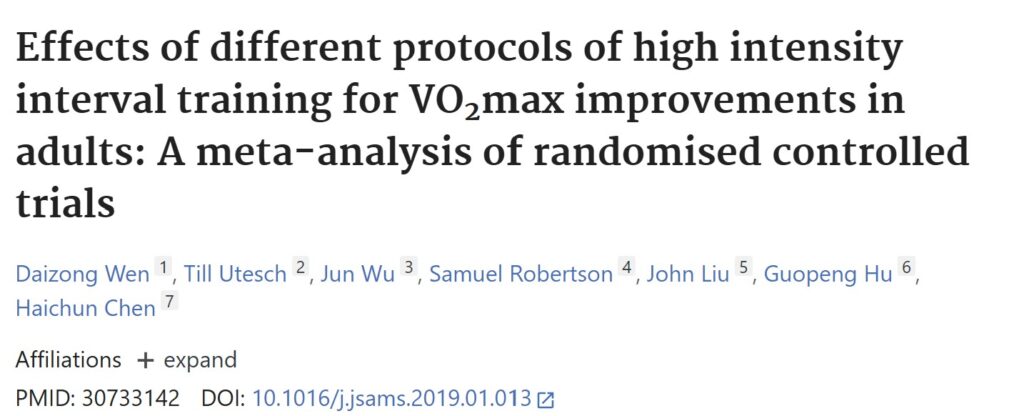
The mission is simple : elevate your VO2 max.
2 detailed options below :
PROGRAM 1 — PURE HIIT (≤ 2h / week) – 4 WEEKS
Who it’s for
- Limited time
- Maximum efficiency
- Strong stimulus, minimal volume
Weekly Structure
- 3 sessions / week
- Total time: 1h15 – 1h45
Session Formats
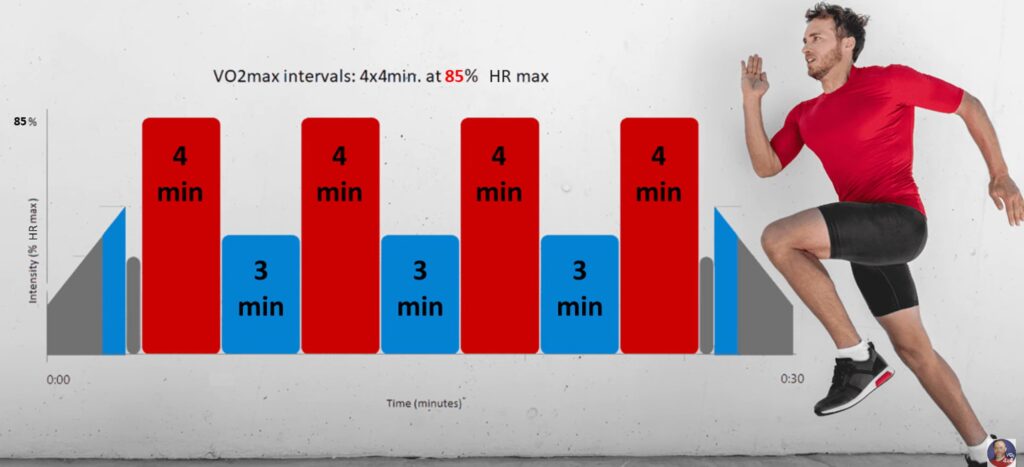
Option A — Long Intervals (most effective)
- warm-up [5–10 min easy cardio (Zone 1–2) & 2–3 short accelerations (20–30 sec)]
- 4 × 4 min @ 85–95% HRmax
- 3 min active recovery
- cool-down
⏱️ Total: ~35 min
Option B — Short Intervals (more accessible)
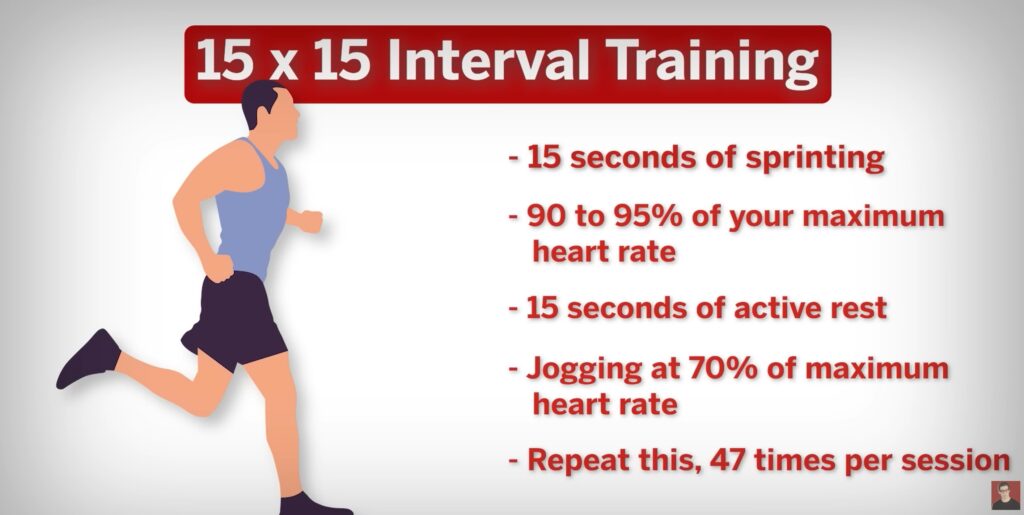
- warm-up [5–10 min easy cardio (Zone 1–2) & 2–3 short accelerations (20–30 sec)]
- 15–15 intervals or 30-30 intervals (15/30 sec ON / 15/30 sec recovery)
- 30 to up to 47 times per session (15/15) or 20-30 times per session.
- Very high intensity
- cool-down
⏱️ Total: ~30 min
📅 Example Week
| Day | Session |
|---|---|
| Monday | 4×4 Intervals |
| Wednesday | 30/30 Intervals |
| Saturday | 4×4 Intervals |
Insights
- HIIT is slightly superior to continuous training for VO₂ max
- Long intervals (>2 min) + sufficient volume (>15 min) maximize adaptations
- Highly time-efficient
⚠️ Limitations
- High fatigue load
- HRV may temporarily decrease
- Requires good recovery
PROGRAM 2 — Zone 2 + HIIT (≤ 6h / week) – 6 WEEKS
Who it’s for
This is the optimal long-term protocol:
- maximizes aerobic adaptations
- supports HRV improvement
- minimizes fatigue accumulation
- sustainable over months
Weekly Structure
- 4 to 5 sessions / week
- Total volume: 3h to 5h+
COMPONENT 1 — Zone 2 (Foundation)
Frequency
- 3 sessions / week
Duration
- 45–60 minutes
Intensity
- 60–70% HRmax
- nasal breathing possible
- able to talk in full sentences
COMPONENT 2 — HIIT (VO₂ Max Driver)
Frequency
- 1 to 2 sessions / week
Option A — Long Intervals (priority)
- warm-up [5–10 min easy cardio (Zone 1–2) & 2–3 short accelerations (20–30 sec)]
- 4 × 4 min @ 85–95% HRmax
- 3 min active recovery
- cool-down
⏱️ Total: ~35 min
Option B — Short Intervals
- warm-up [5–10 min easy cardio (Zone 1–2) & 2–3 short accelerations (20–30 sec)]
- 15–15 intervals or 30-30 intervals (15/30 sec ON / 15/30 sec recovery)
- 30 to up to 47 times per session (15/15) or 20-30 times per session.
- Very high intensity
- cool-down
⏱️ Total: ~30 min
Example:
- 20–50 rounds (depending on level)
📅 Example Week
| Day | Activity | Duration |
|---|---|---|
| Monday | Zone 2 Running | 45+ min |
| Tuesday | HIIT (Long Intervals [option B]) | ~30+ min |
| Wednesday | Active Recovery – Stretching or Yoga | ~30 min |
| Thursday | Zone 2 Running | 45+ min |
| Friday | HIIT (Short Intervals [option A]) | ~30+ min |
| Saturday | Zone 2 Running or Cycling | 45+ min |
| Sunday | Full rest or light recovery | – |
Load Management (CRITICAL for HRV)
Golden rule:
- Never stack HIIT sessions back-to-back
- Always insert low-intensity days between
Weekly Balance
- High stress → HIIT
- Low stress → Zone 2
This alternation is what allows: adaptation instead of accumulation of fatigue
Progression Example
Weeks 1–2
- 1 HIIT + 3 Zone 2
Weeks 3–4
- 2 HIIT + 3 Zone 2
Weeks 5–6
- maintain volume
- improve quality (better pacing, better HR control)
AUTHOR’S NOTE
As discussed earlier, improving aerobic capacity enhances how the body adapts to stress, leading to better resilience and, over time, higher HRV.
HRV is a global proxy, but one of its key foundations is the efficiency of the cardiorespiratory system. Strengthening this system is therefore one of the most effective ways to support long-term HRV improvement.
From both research and practice, the most efficient approach to increase VO₂ max is a combination of:
- Zone 2 training
- and high-intensity intervals (HIIT)
That’s why I’ve proposed two programs — to keep things simple, effective, and adaptable to your schedule.
Whether you run, cycle, or use any other modality, what matters is applying the right stimulus.
Reintroducing high-intensity intervals can feel challenging at first…especially if you haven’t trained this way in a while. But your body adapts quickly — and I can guarantee that once you get back into it, you’ll feel a strong sense of energy, well-being, and satisfaction!
Start progressively, stay consistent, and you’ll first feel the benefits in your body — with HRV improvements following over time.
CONCLUSION
HRV is not just something you measure — it’s something you build over time.
By improving your aerobic capacity, you strengthen the systems that regulate stress, recovery, and overall resilience. While VO₂ max and HRV are not the same, increasing your fitness creates the conditions for HRV to improve over time.
The combination of Zone 2 and HIIT offers a simple and effective path: build the foundation, then apply the stimulus.
Start progressively, stay consistent, and focus on how you feel — energy, recovery, stability.
Because in the end, the goal is not just a higher HRV score, but a body that is stronger, more adaptable, and more resilient.
With much care, Erwin 🙂
F.A.Q
Does improving VO₂ max automatically increase HRV?
Not automatically, but often. VO₂ max (aerobic capacity) and HRV (autonomic regulation) are different systems. However, improving VO₂ max tends to enhance cardiovascular efficiency and vagal activity, which can lead to higher HRV over time — especially with consistent training.
How long does it take to see improvements in HRV from exercise?
Short-term, HRV may even decrease due to training stress. Meaningful improvements typically appear after several weeks to months, once the body adapts and recovery capacity improves. Consistency is key.
Is HIIT enough, or do I need Zone 2 training?
HIIT alone can improve VO₂ max, but combining it with Zone 2 is more effective long-term.
*HIIT provides the stimulus
*Zone 2 builds the foundation and supports recovery
The combination leads to better results and more sustainable HRV improvements.
What if I don’t have time to train several hours per week?
You can still make progress with a minimal HIIT protocol (≤2h/week). Focus on high-quality intervals and proper recovery. While it may be more fatiguing, it remains an efficient way to improve aerobic capacity and support HRV over time.
REFERENCES
[1] Jabbour et al., 2021 — Supramaximal-Exercise Training Improves Heart Rate Variability in Association With Reduced Catecholamine in Obese Adults
[2] Rogers et al., 2021 — Aerobic Threshold Identification Based on HRV Dynamics
