
Mastering HRV: The Breathwork Block for Real, Lasting Resilience
TL;DR
Core Concept: Heart Rate Variability (HRV) measures the subtle, millisecond-by-millisecond variations between heartbeats. It reflects the dynamic balance between your body’s sympathetic nervous system (fight-or-flight) and parasympathetic nervous system (rest-and-digest). Because it captures how efficiently these systems interact, HRV acts as a powerful indicator of your body’s capacity to recover, regulate stress, and adapt to daily demands.
Significance: Higher HRV generally reflects a more resilient and adaptable nervous system, associated with better recovery, stronger emotional regulation, and improved physical and cognitive performance.
Challenges: Improving HRV is rarely a quick process. Meaningful improvements typically take months of consistent lifestyle adaptation, and structural changes can take years. Because HRV is influenced by many factors simultaneously — including sleep, circadian rhythm, aerobic fitness, inflammation, and emotional load — trying to optimize everything at once often leads to confusion and poor compliance.
Implementation Tips – Practical Guidelines (Shared below!) (Scroll down in the full article!)
OVERVIEW
Heart Rate Variability (HRV) has emerged as one of the most powerful biomarkers in modern health and performance science.
It reflects the dynamic balance of the autonomic nervous system and provides insight into several critical physiological dimensions:
- Nervous system balance
- Recovery capacity
- Cardiovascular efficiency
- Inflammatory load
- Emotional regulation
- Global stress burden
In many ways, HRV is a mirror of how well your body adapts to life.
Yet one truth is often overlooked. HRV generally does not increase dramatically in a few weeks.
Most scientific research and long-term observations show that:
- Meaningful increases usually take months
- Structural improvements often require years
- What works best is highly individual
HRV is not a quick hack. It is a reflection of system-wide adaptation.
For this reason, a sustainable HRV strategy should avoid the common trap of stacking every intervention at once. Instead, a structured and progressive approach should provide better clarity.
Rather than trying to optimize everything simultaneously, we isolate key levers and work through them step by step.
Each lever becomes a block. Each block targets a specific physiological system.
Each block builds on the previous one. And each block gradually moves the needle without overwhelming the organism.

Why a Block-Based Strategy Should Works More Easily ?
HRV is influenced by a wide range of domains simultaneously:
- Sleep quality
- Circadian rhythm stability
- Aerobic capacity
- Breath mechanics
- Inflammation levels
- Hormetic stress exposure
- Emotional load
When people try to optimize all of these factors at once, several problems emerge.
First, it becomes impossible to know what actually works.
Second, the accumulation of interventions can create additional stress on the system.
Third, the lack of clarity often leads to plateaus and loss of motivation.
A block-based strategy solves these issues by introducing hierarchy and focus.
We begin upstream with the most accessible physiological levers — the ones that allow direct influence over the autonomic nervous system.
One of the most powerful of these levers is breathing.
The Breathwork Block: Direct Access to the Nervous System
Breathing occupies a unique position in human physiology.
It is one of the only functions that operates both automatically and voluntarily.
Because of this dual control, breathing becomes a gateway into the autonomic nervous system — the system that regulates heart rate, digestion, immune activity, and stress responses.
Through breath training, we can influence:
- Vagal tone
- Cardiovascular regulation
- Emotional stability
- Stress resilience
Breathwork is a vast field, with many different approaches — from the Wim Hof Method to Buteyko breathing and various relaxation techniques.
Rather than trying to combine multiple methods at once, this block is built around the work of Dr. Leah Lagos [1], a clinical psychologist specializing in performance psychology and HRV biofeedback.
Over nearly two decades, her research and clinical work have led to the development of a structured and well-studied protocol designed specifically to improve HRV through resonance breathing.
Her work reframes breath training not as relaxation, but as physiological conditioning.
This makes it an ideal foundation for our breathwork block: a method grounded in long-term research, practical application, and measurable physiological outcomes.
Respiratory Sinus Arrhythmia: The Heart–Breath Connection
To understand why breathing influences HRV so strongly, we must examine a phenomenon known as Respiratory Sinus Arrhythmia (RSA).
RSA describes the natural rhythm linking breathing and heart rate:
- During inhalation, heart rate increases.
- During exhalation, heart rate decreases.
This oscillation is not random. It reflects the constant dialogue between the heart, lungs, and nervous system.
In individuals with strong autonomic regulation, this rhythm resembles large, smooth waves — rising and falling fluidly with each breath.
The difference between the heart rate peak during inhalation and the trough during exhalation is known as “peak-to-trough variability.”
Greater amplitude in these oscillations corresponds with higher HRV and a more adaptive nervous system.
Breath training works by amplifying these oscillations.
Over time, this strengthens one of the body’s most important regulatory systems: the baroreflex.
The Baroreflex: The Hidden Regulator of Stress
The baroreflex is a homeostatic mechanism responsible for regulating blood pressure and heart rate in real time.
Specialized sensors located in the arteries constantly monitor pressure changes and signal the brain to adjust cardiovascular activity.
A strong baroreflex allows the body to respond to stress with remarkable precision.
Dr. Lagos uses a simple analogy to illustrate this transformation. Without training, the nervous system functions like a reliable family car. It works, but its responses are moderate and slow.
With targeted breath training, the system becomes more like a high-performance sports car. It can accelerate rapidly when faced with a challenge, and just as quickly return to a calm baseline once the challenge passes.
This ability to shift states efficiently is the essence of resilience.
The Key Principle: Resonance Frequency Breathing
A central discovery in HRV training is that each individual has a specific breathing rhythm that maximizes autonomic regulation.
This rhythm is known as the resonance frequency.
For most people, it falls between 5 and 6.5 breaths per minute.
At this rhythm, the cardiovascular system enters a state of physiological resonance, producing heart rate oscillations around 0.1 Hertz.
This frequency synchronizes multiple systems simultaneously:
- The vagus nerve
- Blood pressure regulation
- Respiratory rhythms
- Brain–heart communication
The result is a powerful activation of the parasympathetic nervous system, the branch responsible for recovery and restoration.
Finding this resonance frequency is often done using biofeedback tools, but approximate protocols can still deliver significant benefits.
INTERESTING VIDEOS TO WATCH
HOW TO GET INTO HACKTION?

Practical Instructions – The 10-Week Conditioning Protocol (From Dr LAGOS [1])
Increasing HRV through breathing is not an overnight process.
Dr. Lagos emphasizes that the goal is physiological conditioning, not momentary relaxation.
Her clinical protocol typically involves:
15-20 minutes of breathing practice twice per day
for 10 consecutive weeks
This consistency allows the nervous system to gradually adopt the new breathing rhythm as its baseline regulatory pattern. Several key elements define the practice.
How to Follow the Breathwork Protocol in Practice
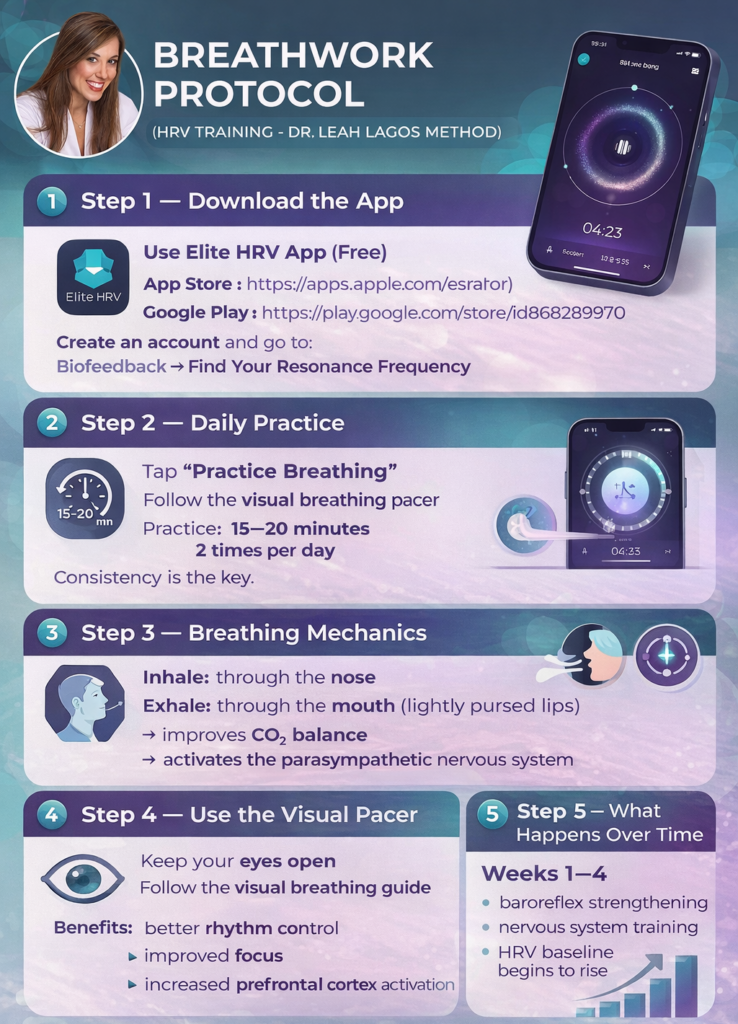
To make this protocol easy to follow, I strongly recommend downloading the Elite HRV app, which is free.
You can download it here:
- iOS (App Store): https://apps.apple.com/us/app/elite-hrv/id868829970
- Android (Google Play): https://play.google.com/store/apps/details?id=com.elitehrv.app
Once installed, simply create an account.
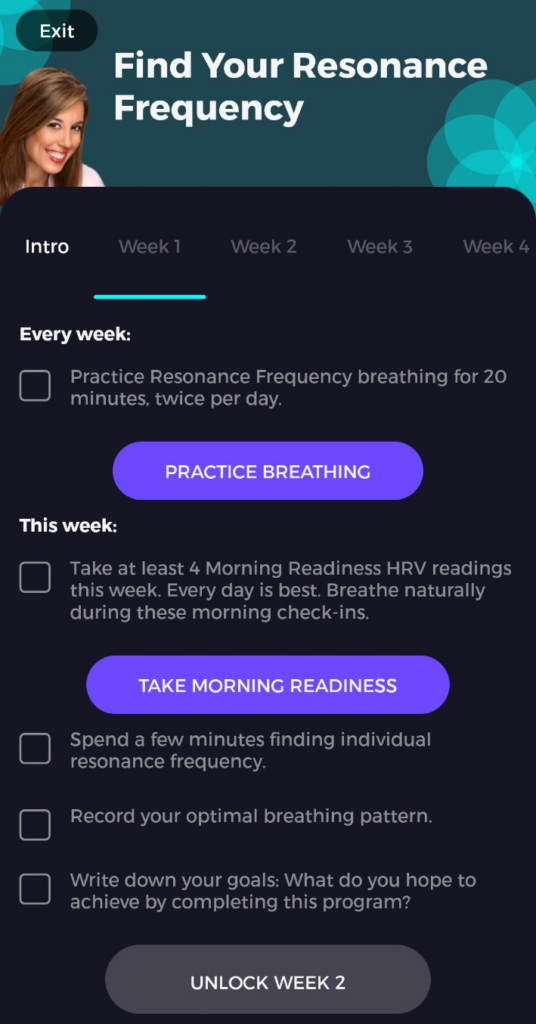
Inside the app, go to the Biofeedback section where you will find the Dr. Leah Lagos protocol (Intro + Week 1).
From there, the process is very straightforward.
Tap “Practice Breathing”, adjust your inhale and exhale durations if needed, and follow the visual breathing guide on the screen. The app will pace your breathing and help you maintain the correct rhythm.
This is the tool I recommend for completing the protocol:
15–20 minutes of breathing practice, twice per day, following the structured progression provided in the app.
By using a visual pacer and tracking your sessions consistently, you give your nervous system the best chance to adapt and progressively increase HRV over time.
Breathing Mechanics
Inhalation occurs through the nose, allowing the air to be filtered, warmed, and humidified.
Exhalation occurs through the mouth with lightly pursed lips, similar to gently blowing on hot soup.
This controlled exhalation promotes greater release of carbon dioxide and enhances parasympathetic activation.
Visual Pacers
Rather than closing the eyes or simply following music, practitioners are encouraged to keep their eyes open and follow a visual breathing pacer.
This subtle detail has cognitive benefits.
Maintaining visual focus increases oxygenation and blood flow to the prefrontal cortex, the brain region responsible for executive function, attention, and emotional regulation.
Progressive Adaptation
The first four weeks primarily strengthen the baroreflex and begin to elevate baseline HRV.
Around week four, many individuals begin to notice subtle changes:
- Reduced reactivity to stress
- Greater emotional stability
- Faster recovery from pressure situations
Between weeks five and ten, the protocol can incorporate advanced techniques that combine breathing with positive emotional memory recall, reinforcing safety signals in the nervous system.
AUTHOR’S NOTE
Among the different levers that influence HRV, breathwork — especially resonance breathing — is one of the most accessible ways to regulate the autonomic nervous system.
Many breathing methods exist (Wim Hof, Buteyko, and others), but the work of Dr. Leah Lagos stood out to me because it offers a structured protocol supported by years of research and practical application.
I personally experimented with the Elite HRV app several years ago and followed the protocol for a while. At the time, however, I was dealing with significant fatigue and health challenges, and breathwork alone was not enough to significantly impact my HRV.
What I learned from that experience is that the real challenge of this protocol is consistency. Practicing 15–20 minutes twice per day for 10 weeks requires discipline and routine.
Doing this protocol as a group challenge creates accountability and motivation, which makes it a much stronger opportunity to follow the method all the way through and observe its effects.
CONCLUSION
HRV reflects how well your body adapts to stress, recovers, and maintains balance. Because it integrates many physiological systems, improving HRV requires consistency and long-term habits, not quick hacks. Breathwork offers one of the most direct ways to influence the autonomic nervous system. The protocol developed by Dr. Leah Lagos provides a structured method to train this capacity over time. The real challenge is consistency — which is why approaching it as a collective challenge can make all the difference.
Erwin
F.A.Q
How long does it take to see improvements in HRV?
HRV improvements usually take time. While some people notice better relaxation and stress regulation within a few weeks, meaningful increases in HRV typically occur over several months of consistent practice.
Can medications affect HRV?
Absolutely. Certain medications, especially those for blood pressure like beta-blockers and calcium channel blockers, can significantly reduce your HRV. ACE inhibitors tend to have less of an impact. It’s important to discuss this with your doctor if you are tracking HRV and on medication.
What if I miss a breathing session?
Consistency matters more than perfection. If you miss a session, simply resume your practice at the next scheduled time. The goal is to maintain regular daily practice over the long term.
Do I need a device to benefit from this protocol?
No device is strictly required to practice the breathing technique. However, tools like the Elite HRV app can help guide your breathing rhythm and track progress, making the protocol easier to follow.
What breathing rhythm should I use?
Most people reach optimal resonance between 5 and 6.5 breaths per minute. The Elite HRV app helps you identify your personal resonance frequency and maintain the correct inhale–exhale timing.
REFERENCES
[1] https://drleahlagos.com/