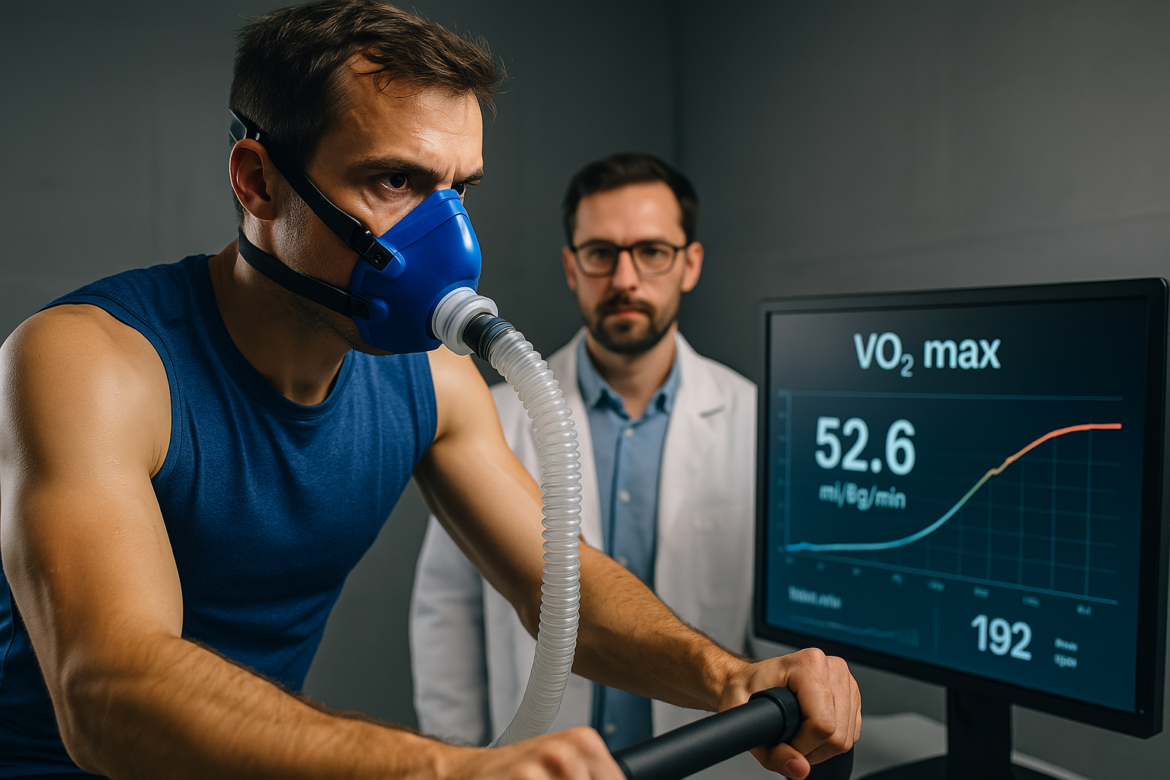
Test Your Engine: How VO2 Max Reveals Your True Health and Longevity Potential
TL;DR
Core Concept: VO2 max is the “engine capacity” of your aerobic system, reflecting how efficiently your body transports and uses oxygen to produce energy.
Significance: It’s one of the strongest predictors of longevity and a sensitive marker for cardiovascular, metabolic, and even cognitive health.
Challenges: Most people have no clue about their VO2 max and severely underestimate the importance of training to improve it. Sedentary lifestyles and natural aging make the decline even worse.
Strong Fact: Studies show that a low VO2 max is linked to an all-cause mortality risk as high (or higher) than well-known chronic conditions like type 2 diabetes or heart disease.
Implementation Tips – Practical Guidelines (Shared below!)
Measure your VO2 max via lab tests or field estimations, and integrate High-Intensity Interval Training (HIIT) and Zone 2 endurance training into your weekly routine.. Scroll down for actionable steps!
OVERVIEW
Your VO2 max — the maximum amount of oxygen your body can use during intense exercise — is way more than just a performance metric for athletes. It’s a powerful predictor of your overall health and longevity.
This article dives deep into why VO2 max matters, how to measure it, and most importantly, how to upgrade it using proven strategies. Let’s picture a future where your VO2 max is monitored as routinely as a blood test — driving tailored exercise prescriptions to help you live longer, healthier, and sharper.
Definition
VO₂ max stands for:
- V → Volume
- O₂ → Oxygen
- max → Maximum
In simple terms, VO₂ max is the maximum volume of oxygen your body can absorb, transport, and utilize during intense exercise. It’s a gold-standard indicator of your cardiovascular fitness and endurance.
It is usually measured in milliliters of oxygen per minute per kilogram of body weight (ml/kg/min).
The higher your VO₂ max, the more capable you are of sustaining effort for extended periods — because your muscles receive and use oxygen efficiently.
But here’s the key: VO2 max is not just about athletic performance.
Why Should You Care About VO2 Max?
Imagine your body as a highly complex machine powered by oxygen. VO2 max measures the full capacity of that machine to consume and use this precious fuel during physical effort.
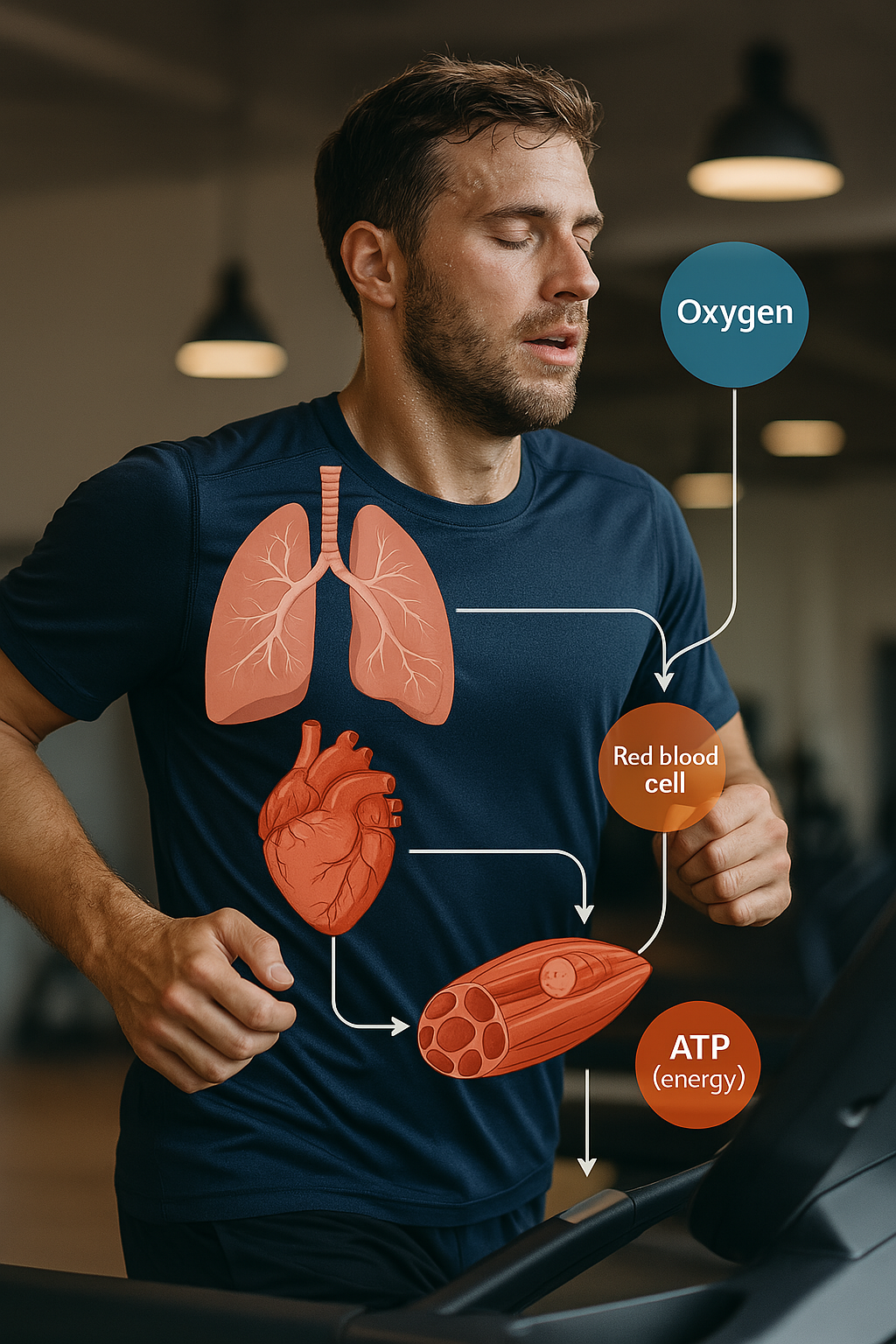
Physiologically, it reflects how well multiple systems work together: your lungs extract oxygen, your heart pumps it into the bloodstream, your red blood cells transport it, and your muscles use it in the mitochondria to produce ATP (energy).
A high VO2 max means all these systems are operating optimally, enabling you to handle higher activity levels for longer.
But its importance goes far beyond sports performance — it’s a robust marker of your general health and life expectancy.
Peter Attia, MD, often highlights VO2 max as possibly the single most powerful marker of aerobic fitness and one of the strongest predictors of lifespan.
Higher VO2 max is strongly associated with reduced risk of chronic diseases like heart disease and metabolic disorders. On the flip side, low VO2 max is a major red flag, often linked with increased mortality risk.
Common Challenges With VO2 Max
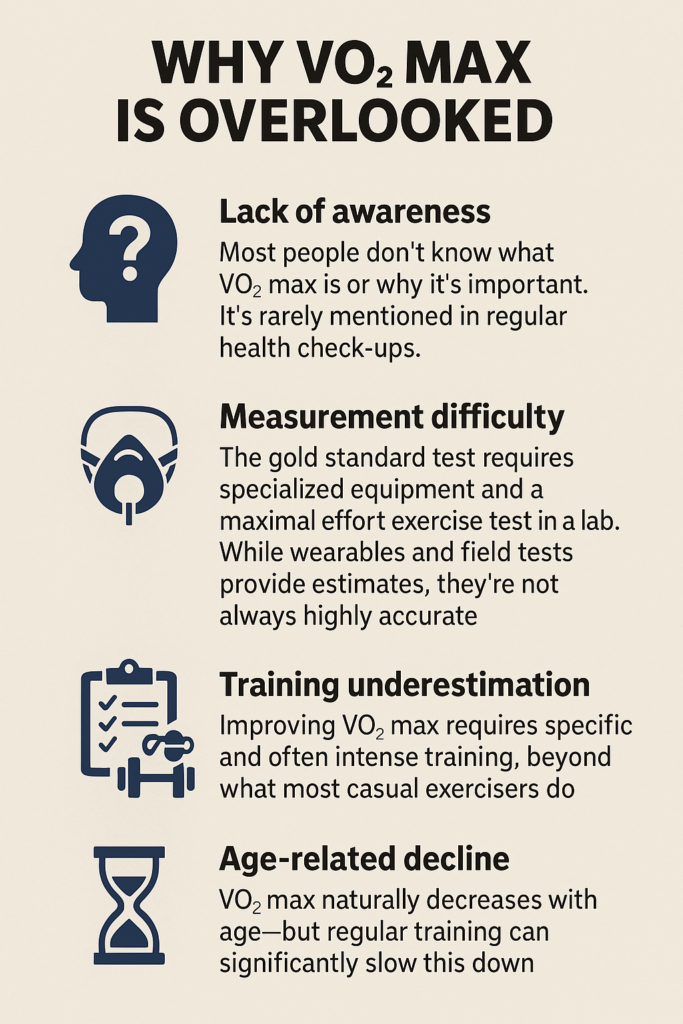
Despite its critical importance, VO2 max is often ignored in routine health checks. Here’s why:
- Lack of awareness: Most people don’t know what VO2 max is or why it’s essential. It’s rarely mentioned in regular health check-ups.
- Measurement “difficulty”: The “gold standard” test requires specialized equipment and a maximal effort exercise test in a lab. While wearables and field tests provide estimates, they’re not always highly accurate. And people get stuck at this “gold standard” measurement, where a good estimation could be simply used to set a baseline and start to improve VO2 Max score.
- Training underestimation: Improving VO2 max requires specific and often intense training, beyond what most casual exercisers do.
- Age-related decline: VO2 max naturally decreases with age — but regular training can significantly slow this down.
Hard Facts to Motivate You (Science Based)
The science is clear (and frankly, hard to ignore):
- Strong link with longevity: Numerous studies show a significant inverse relationship between VO2 max and all-cause mortality. The higher your VO2 max (adjusted for age and sex), the longer you’re likely to live. [1]
- High mortality risk with low VO2 max: A 2018 study published in JAMA found that people in the lowest quartile for VO2 max had a 40% higher risk of death compared to those with average VO2 max — similar or even worse than smoking or chronic disease. [2]
- You can improve it at ANY age: Contrary to popular belief, VO2 max can be improved no matter your age. Studies on 70+ years old athletes show VO2 max levels comparable to much younger individuals.[3]

INTERESTING VIDEOS TO WATCH
INTERESTING PODCAST TO LISTEN TO
HOW TO GET INTO HACKTION?

Turning VO2 max into a key health marker (like a blood test) requires knowing how to measure it and, most importantly, how to improve it.
Practical Instructions
1/ Measure (or estimate) your VO2 max:
- Lab Test (gold standard): Book a maximal exercise test at a sports physiology lab. Your doctor may even prescribe it.
- Cooper Test (simplified but effective): Run as far as possible in 12 minutes.
Use a gps tracker or a track field to know the exact distance you run.
Use an [online calculator] to estimate your VO2 max based on the distance covered.
Here is a tutorial video to guide you better :
- Wearables & Apps: Many devices now estimate VO2 max. While not 100% precise, they provide valuable trend data. Make sure your personal data (weight, age, etc.) is up-to-date for better accuracy.
On WHOOP:
→ Navigate to Strain > VO2 max.
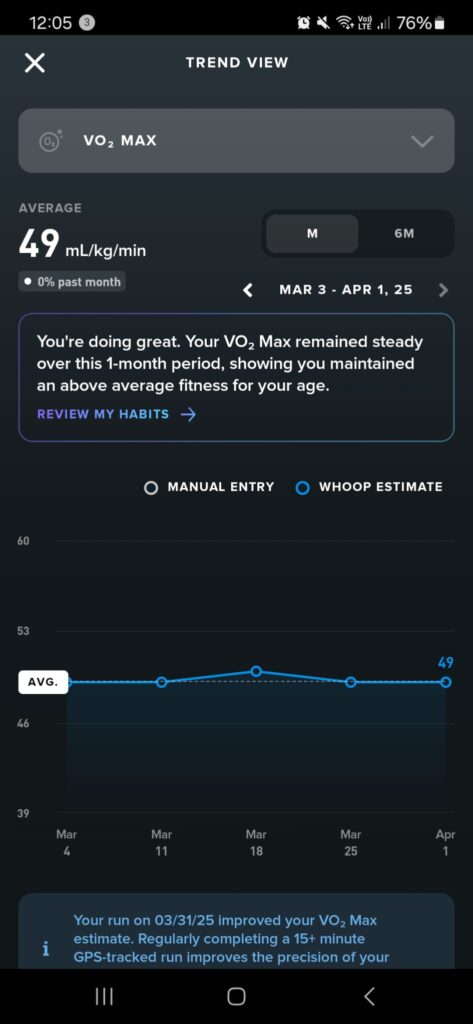
For better calibration, manually log a 15-minute run with GPS tracking.
If you’re unsure about wearable accuracy, check this breakdown from the @quantifiedScientist : Watch this video
2/ Know where you stand for your age
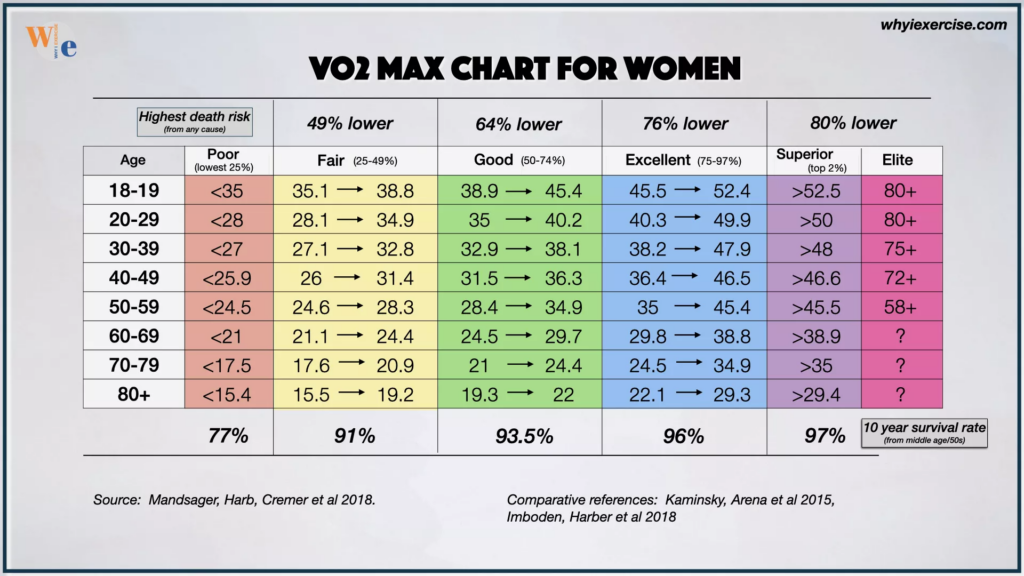
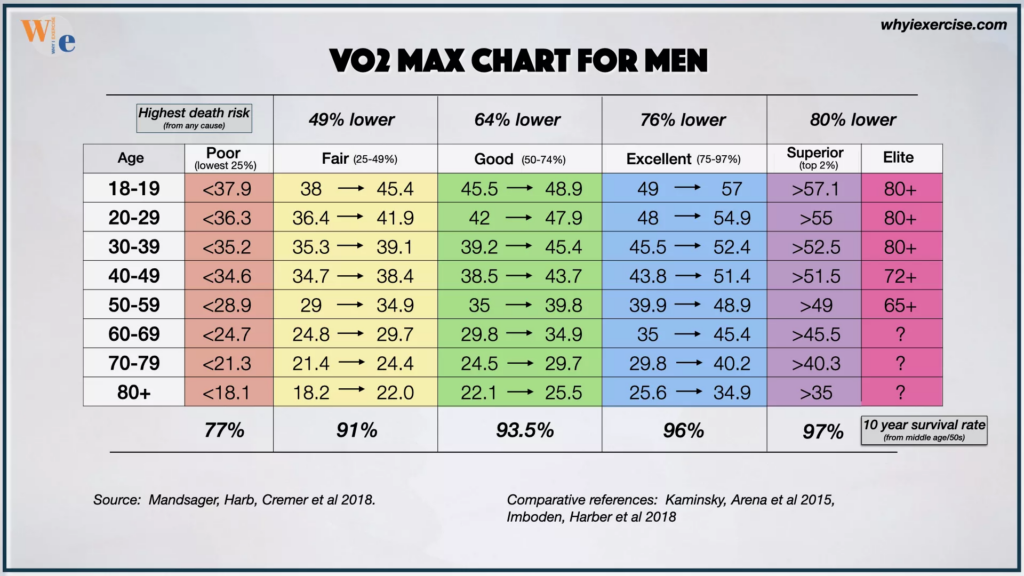
(source : https://www.whyiexercise.com/VO2-Max.html)
3/ Follow this “Training Prescription” Focused on VO2 Max
🎯 Goal:
The mission is simple but powerful: elevate your VO2 max by combining Zone 2 endurance training and HIIT, unlocking massive benefits for your health, performance, and longevity.
But how high should you aim?
You can tailor your ambition based on your current fitness level and mindset. Here are 4 progressive and realistic targets:
- Baseline Target: Reach the Good category for your age and sex (reflects adequate cardiorespiratory fitness).
- Recommended Target: Reach the Excellent category, associated with lower risk of cardiovascular and metabolic diseases for your demographic.
- Ambitious Target: Reach the Superior category for your age group, which correlates with a significant reduction in all-cause mortality.
- Optimal Longevity Target: Reach the Superior category of individuals approximately 10 years younger than you.
This is a commonly accepted benchmark in longevity science to offset the typical age-related decline in VO2 max and maintain functional independence later in life.
🎯 Scientific Foundations Behind the Protocol
Polarized Training:
The most efficient method is a combination of mostly Zone 2 training with regular HIIT sessions. The well-known 80/20 rule (80% low-intensity, 20% high-intensity) applies to high-volume endurance athletes.
For most people training <5-6 hours/week, a 60/40 or 70/30 split may work better. In this protocol, we’ll recommend first to use a 60/40 approach for practical and time-efficiency reasons.
- Zone 2 = moderate intensity improving aerobic endurance without excessive stress.
Typically 60-70% of your max heart rate (HRmax). - Zone 5 = very high intensity, between 90-100% HRmax, used during HIIT efforts.
🗓 Recommended Duration:
Minimum 3 months for optimal results.
📌 Weekly Structure (5 sessions)
- 3x Zone 2
- 2x HIIT
Total: 5 sessions per week.
📌 Effective Dose [for those that are short on time].
| Type | Weekly Time | Ratio |
|---|---|---|
| Zone 2 | 30 min/session | 90 mn | 60% |
| HIIT | 25mn+/session | 60 min | 40% |
| Total | 150 min (≈2.5 hrs) | 100% |
📌📌 More impactful version if you have the proper time to train
| Type | Weekly Time | Ratio |
|---|---|---|
| Zone 2 | 45 min+/session | 120 min | 70% |
| HIIT | 25mn+/session | 60 min | 30% |
| Total | 195 min (≈3.25 hrs) | 100% |
📈 1. Zone 2 Training
- Frequency: 3 times/week
- Duration per session: 30-40 min
- Intensity:
- Heart rate between 60-70% of your HRmax
- Mainly nasal breathing, comfortable effort, able to hold a conversation
Examples:
Slow running, easy cycling, brisk incline walking
🔥 2. HIIT Sessions
Option A – Short Intervals (time-efficient)
- Frequency: 1x/week
- Structure:
- Warm-up (5 min)
- Running / Sprints -8 rounds
- 1 min all-out (Zone 5)
- 1 min easy walk
- Cool-down (5 min)
Total time: ~25 min
Option B – Long Intervals (more effective long-term) – Norwegian 4×4 HIIT or Sprints
- Frequency: 1x/week
- Structure:
- Warm-up (5-10 min)
- 4 rounds:
- 3-4 min hard (Zone 5)
- 4 min active recovery
- Cool-down (5 min)
Total time: ~35 min
🗒 Sample Weekly Schedule
| Day | Activity | Duration |
|---|---|---|
| Monday | Zone 2 Running | 30-45+ min |
| Tuesday | HIIT (Short Intervals [option A]) – Sprints | ~25 min |
| Wednesday | Active Recovery – Stretching or Yoga | ~30 min |
| Thursday | Zone 2 Running | 30-45+ min |
| Friday | HIIT (Long Intervals [option B]) 4×4 Norwegian or Sprints [Workout video] | ~35 min |
| Saturday | Zone 2 Running or Cycling | 30-45 min |
| Sunday | Full rest or light recovery | – |
📱 To Check your zones on WHOOP
- Open WHOOP app
- Menu ≡ → Settings → Training Zones → Heart Rate Zones
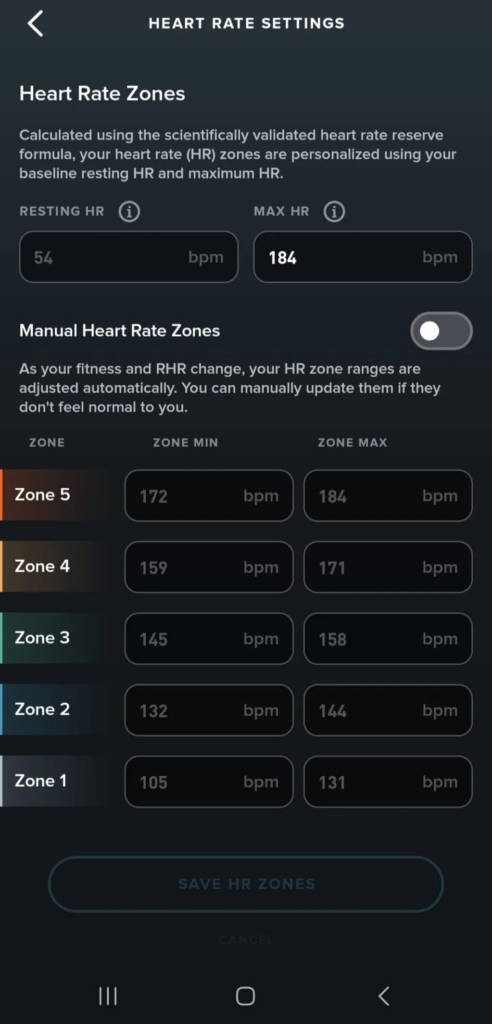
Typical WHOOP zones are :
| Zone | Intensity | % HRmax |
|---|---|---|
| 1 | Very low | 50-60% |
| 2 | Low (Endurance) | 60-70% |
| 3 | Moderate | 70-80% |
| 4 | High | 80-90% |
| 5 | Very High | 90-100% |
Quick DIY calculation (no tracker)
Step 1: Estimate your HRmax (example)
Simple formula: HRmax = 220 − age
(Ex: age 35 → HRmax = 185 bpm)
Step 2: Calculate your Zones (example)
- Zone 2 = 60-70% of HRmax
→ 111 – 130 bpm if HRmax = 185
💡 Don’t overthink the numbers if you don’t have a heart rate monitor. You can rely on perceived effort instead:
Zone 2 : Nasal breathing only sustainable, light effort, comfortable, able to talk.
Zone 5 : Close to your maximum effort, breathing is heavy, speaking becomes difficult, you are pushing to your limits.
4/ Track Your Progress to Stay on Track
Initial & final VO2 max test (cf. 3/):
Ideally via a lab test or a Cooper Test (12-min run).
Record your baseline and compare after 12 weeks (3 months).
Ongoing tracking:
Use a heart rate monitor that offers the VO2 max score (WHOOP, Garmin, Apple Watch) to follow trends and improvements.
CONCLUSION
VO2 max is a powerful health marker, just as important as your blood test results. It gives you direct insight into your body’s ability to use oxygen — a key factor for performance, health, and longevity.
By understanding, measuring, and training strategically, you can take control of your aerobic fitness and invest in a healthier, longer life.
Imagine your doctor guiding you on VO2 max just like they would for cholesterol — prescribing personalized physical activity to make the most of this hidden superpower. This future is within reach if we give VO2 max the attention it deserves.
Thanks to the evidence based protocol shared, you can now start to measure and improve your VO2 Max.
F.A.Q
What is considered a good VO2 max?
It depends on your age, sex, and fitness level. Elite endurance athletes often reach values above 70 to 80 ml/kg/min.
How often should I train to improve my VO2 max?
Aim for at least 2 HIIT sessions and 2 Zone 2 endurance sessions per week.
How long does it take to see improvements in VO2 max?
With regular and appropriate training, you can notice improvements within a few weeks.
Does age affect my ability to improve VO2 max?
Although VO2 max naturally decreases with age, it can still be significantly improved through proper training, even in older adults.
Can I improve my VO2 max with Zone 2 training alone?
While Zone 2 training is excellent for cardiovascular health, it may not be sufficient alone to maximize VO2 max improvements. Combining it with HIIT is the most effective approach.
REFERENCES
[1] Clausen, J. S. R., Marott, J. L., Holtermann, A., Gyntelberg, F., & Jensen, M. T. (2018). Midlife cardiorespiratory fitness and the long-term risk of mortality: 46 years of follow-up. Journal of the American College of Cardiology, 72(9), 987–995. https://doi.org/10.1016/j.jacc.2018.06.045[2] Mandsager, K., Harb, S., Cremer, P., Phelan, D., Nissen, S. E., & Jaber, W. (2018). Association of cardiorespiratory fitness with long-term mortality among adults undergoing exercise treadmill testing. JAMA Network Open, 1(6), e183605. https://doi.org/10.1001/jamanetworkopen.2018.3605[3] Strasser, B., & Burtscher, M. (2018). Survival of the fittest: VO2 max, a key predictor of longevity? Frontiers in Bioscience-Landmark, 23(8), 1505–1516. https://doi.org/10.2741/4657