
All Day Focus & Energy Beginners guide
TL;DR
Significance: Supporting the foundations of brain and metabolic health restores stable focus, sustained energy, and mental clarity — without relying on stimulants, pushing performance, or chasing endless supplements.
Core Concept: All Day Focus & Energy is not a quick hack or a short-term protocol. It’s the result of continuous, physiology-aligned support of key systems: nutrition, hydration, hormones, neurotransmitters, gut health, and lifestyle — allowing the brain to function smoothly from morning to evening.
Challenges: Most people face hidden and cumulative stressors: undetected nutrient deficiencies, hormonal imbalances, digestive issues, blood sugar instability, chronic stress, poor sleep, and inflammatory food inputs. These operate below the surface, gradually eroding focus and energy while symptoms are masked with caffeine and sugar.
Strong Fact: When core physiological needs are met — adequate micronutrients, stable blood sugar, proper hydration, low inflammation, and balanced recovery — the body naturally restores cognitive clarity, emotional stability, and sustainable energy. The fundamentals consistently work.
Implementation Tips – Practical Guidelines (Shared below!) (Scroll down in the full article!)
OVERVIEW
Feeling tired despite sleeping, struggling to concentrate, or experiencing brain fog throughout the day?
Many people assume this is simply part of modern life — stress, workload, screens, or aging. In reality, persistent focus and energy issues are often signals that the body and brain are not functioning in optimal conditions.
All-day focus and energy are not about being constantly stimulated or hyper-productive. They are about maintaining stable mental clarity, emotional balance, and physical vitality from morning to evening — without relying on sugar, caffeine, or “energy” drinks to survive the day.
When the underlying factors that regulate brain function are supported — nutrition, hydration, hormones, neurotransmitters, and lifestyle — focus becomes more natural, energy more consistent, and mental fatigue far less dominant.
The ideal outcome is simple but powerful:
- Clear thinking
- Calm alertness
- Fewer crashes
- Better mood regulation
- Sustainable energy without overstimulation
This guide is designed as a foundational roadmap for beginners who want to understand why focus and energy decline, and how to restore them through practical, biology-aligned actions.
What Is “ALL DAY FOCUS & ENERGY” ? (Definition)
“All Day Focus & Energy” refers to the body’s ability to sustain mental alertness, attention, motivation, and physical energy throughout the day without extreme fluctuations.
When this system is functioning well:
- The brain remains engaged without tension
- Energy feels stable rather than spiky
- Mood remains relatively balanced
- Focus is accessible without force
On WHOOP, this state typically corresponds to:
- Stable Green Recovery scores
- Consistent upper HRV trends
- Adequate sleep performance
- Strain aligned with recovery capacity
When it is not:
- Brain fog appears
- Attention becomes fragmented
- Energy crashes occur mid-day
- Mood swings increase
- Dependence on stimulants rises
On WHOOP, this often shows up as:
- Low or declining Recovery
- Suppressed HRV
- Poor sleep efficiency or duration
- High strain without adequate recovery
- Day-to-day volatility in scores
Focus and energy are not isolated brain issues. They are the result of multiple interconnected systems, including:
- Hormonal balance
- Neurotransmitter activity
- Micronutrient availability
- Digestive health
- Blood sugar regulation
- Hydration status
- Environmental exposures
Understanding this complexity is key. Focus problems are rarely about laziness or lack of willpower — they are often physiological mismatches between what the brain needs and what it receives.
Why Should You Care ?
Focus and energy shape how you experience your life.
When they are low:
- Simple tasks feel overwhelming
- Motivation drops
- Decision-making becomes harder
- Emotional reactivity increases
- Productivity becomes inconsistent
- Enjoyment decreases
Over time, chronic low energy and poor focus can affect:
- Work performance
- Learning capacity
- Emotional resilience
- Relationships
- Long-term brain health
On the other hand, restoring stable focus and energy can:
- Improve confidence and clarity
- Support emotional balance
- Reduce mental fatigue
- Increase daily efficiency
- Enhance overall quality of life
Importantly, improving focus is not about pushing harder. It is about removing friction, correcting deficiencies, and supporting the brain’s natural chemistry so that attention and energy emerge organically.
Why This Is Tricky (Common Challenges)
Many people struggle to improve focus and energy because the real causes are often hidden or misunderstood.
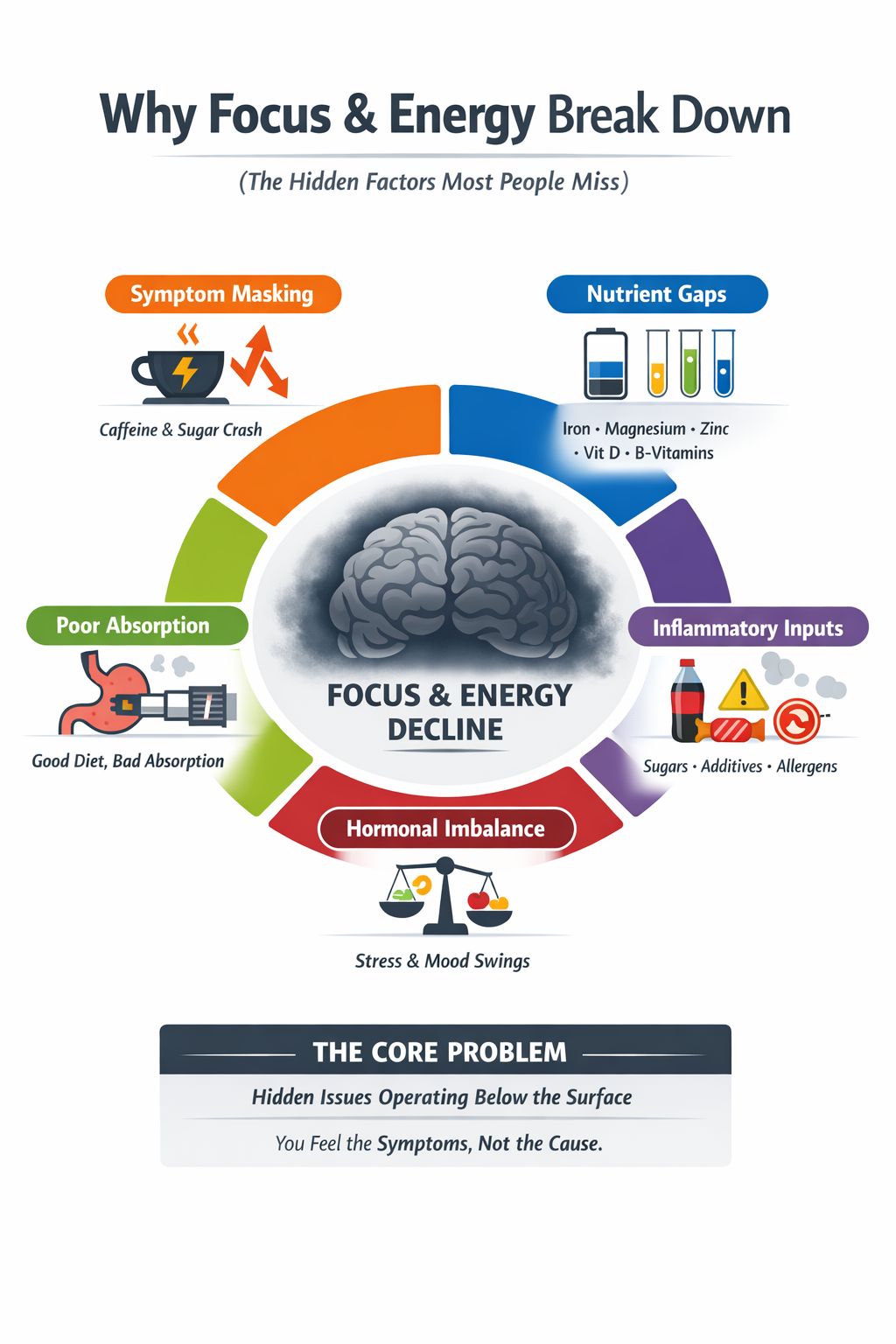
1. Masking Symptoms Instead of Addressing Causes
Caffeine, sugar, and energy drinks provide short-term stimulation but do not correct underlying imbalances. Over time, they can worsen fatigue and attention problems.
2. Undetected Nutrient Deficiencies
Key nutrients involved in brain function — such as iron, magnesium, zinc, vitamin D, and B-vitamins — are frequently low, yet rarely tested.
3. Digestive Issues and Malnutrition
Even with a “good” diet, digestive problems can prevent proper nutrient absorption, leading to functional deficiencies that directly impact brain performance.
4. Hormonal Imbalances
Hormones regulate metabolism, mood, stress response, and mental energy. When they are off balance, focus and energy inevitably suffer.
5. Food-Related Triggers
Refined sugars, food additives, coloring agents, and common food allergies can silently contribute to brain fog, hyperactivity, and attention issues.
These challenges persist because they often operate below the surface, gradually eroding mental performance without obvious warning signs.
INTERESTING VIDEOS TO WATCH
HOW TO GET INTO HACKTION?

Practical Instructions
This section translates principles into clear, actionable steps.
Step 1: Identify Root Causes (Test, Don’t Guess)
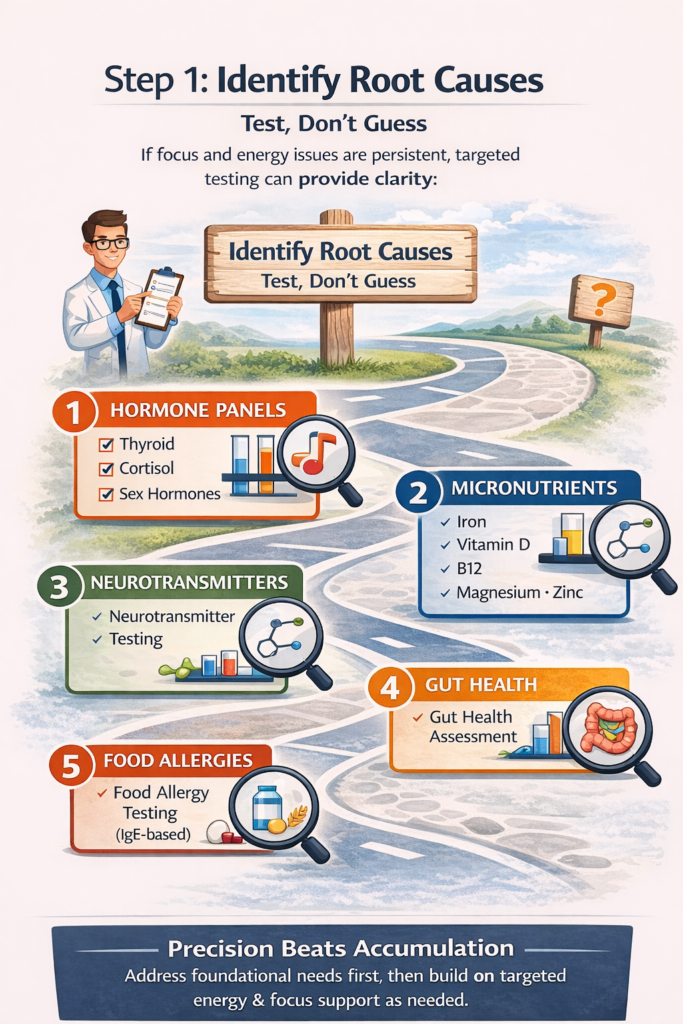
If focus and energy issues are persistent, targeted testing can provide clarity:
- Hormonal panels (thyroid, cortisol, sex hormones)
- Micronutrients (iron, vitamin D, B12, magnesium, zinc)
- Neurotransmitter testing
- Gut health assessment
- Food allergy testing (IgE-based)
Understanding what is out of balance allows for more precise and effective action.
The most effective option is to consult with a functional practitioner to assess properly what is out of balance.
Step 2: Remove Focus Killers (Immediate Wins)
Reducing or eliminating the following can significantly improve energy and mental clarity:
- Refined sugars and simple carbohydrates (remember this article ? )
- Artificial food coloring
- Harmful food additives and preservatives
- Juice and soda
- Excess caffeine and stimulants
These substances can disrupt blood sugar, increase inflammation, and interfere with brain chemistry.
Step 3: Build a Brain-Supportive Diet
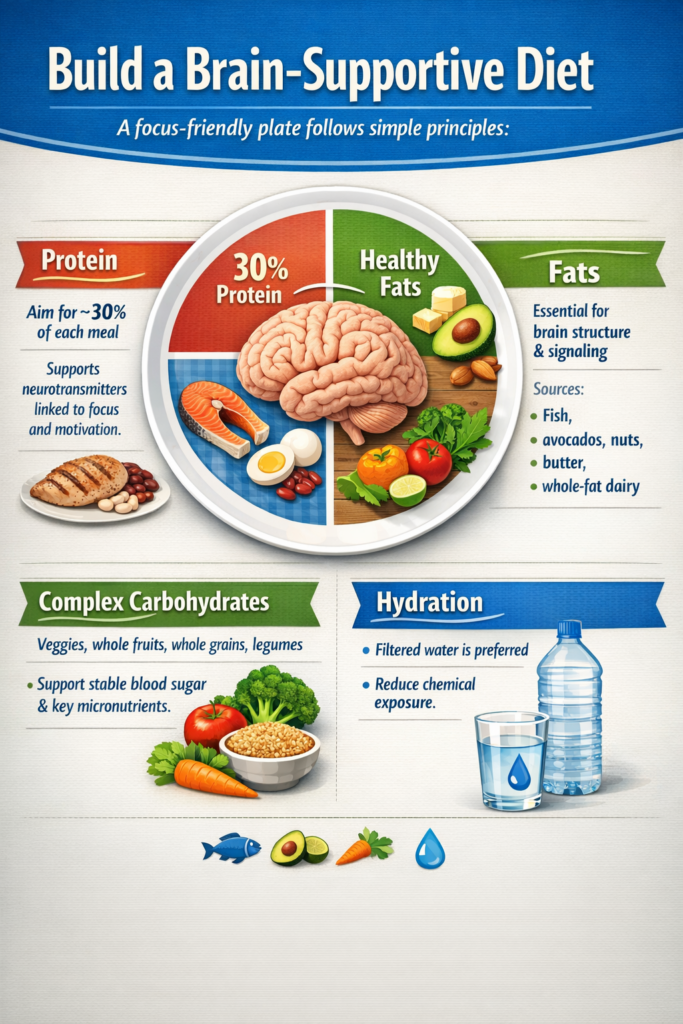
A focus-friendly plate follows simple principles:
Protein
- Aim for roughly 30% of each meal
- Supports neurotransmitters linked to focus and motivation
Healthy Fats
- Essential for brain structure and signaling
- Sources include fish, whole-fat dairy, butter, avocados, nuts, and seeds
Complex Carbohydrates
- Vegetables, whole fruits, whole grains, legumes
- Support stable blood sugar and provide key micronutrients
Hydration
Filtered water is preferred to reduce chemical exposure.
Step 4: Key Nutrients That Support Focus & Energy
Certain nutrients play a central role in body and brain performance:
Foundational Support (Daily Basics)
- Magnesium
Supports nervous system regulation, stress resilience, and cellular energy production. - B-Vitamins (B6, B9, B12)
Support energy metabolism, neurotransmitter synthesis, and dopamine pathways.
(Best taken as an activated B-complex) - Vitamin D
Linked to mood regulation, cognitive function, and overall energy levels. - Zinc
Supports dopamine balance, attention, and immune function. - Iron (if deficient)
Essential for oxygen transport and sustained mental focus. - High-quality Multivitamin
Provides a solid micronutrient foundation to cover common gaps.
Mitochondrial & Cellular Energy Support
- Creatine
Supports ATP production, mental energy, and cognitive performance — not only for athletes. - L-Carnitine / Acetyl-L-Carnitine (ALCAR)
Supports mitochondrial fat transport and brain energy metabolism.
(ALCAR is more neuro-focused) - Coenzyme Q10 (CoQ10 / Ubiquinol)
Supports mitochondrial respiration and cellular energy output. - Alpha-Lipoic Acid (ALA)
Mitochondrial cofactor and antioxidant supporting metabolic and cognitive energy.
Neuro-Energy & Focus Support (Non-Stimulant)
- Omega-3 Fatty Acids (EPA & DHA)
Support neuronal membrane fluidity, attention, mood, and brain resilience. - L-Tyrosine
Dopamine and norepinephrine precursor supporting focus, motivation, and stress adaptation. - Phosphatidylserine
Supports neuronal membrane health, stress regulation, and cognitive performance.
Deficiencies in these nutrients can directly impair focus and energy.
AUTHOR’S NOTE
From experience, when dealing with fatigue and cognitive issues — deep fatigue, brain fog, mental overload, and what many describe as mental fog — one thing becomes very clear: restoring focus and energy is often not a quick fix, but a process.
It can be a long road at times. But again and again, the fundamentals prove to be reliable.
Proper micro nutrition, hydration, a consistent anti-inflammatory diet. Targeted cognitive support. And solid gut support.
When approached through a true biohacking mindset — meaning measure, adjust, re-measure — this naturally leads to testing before and after, ideally with the guidance of a functional medicine practitioner and lab-based assessments. What used to feel marginal or inaccessible eight years ago has now become much more common. This ecosystem has matured, and it makes sense to take advantage of it.
What stands out, over time, is that the fundamentals always work.
What once seemed out of reach eventually comes back into perspective: our physiology is capable of delivering sustained energy and clear focus throughout the day — without pushing the system, without overstressing the body, and without relying on an endless stack of supplements just to get through the day.
This is not about forcing performance.
It’s about balance.
When the core physiological needs are respected, biology expresses itself naturally — through vitality, harmony, and strength.
CONCLUSION
All Day Focus & Energy is not about forcing performance — it is about restoring balance.
When the brain receives:
- Proper nutrients
- Adequate hydration
- Hormonal support
- Stable blood sugar
- Reduced inflammatory triggers
Focus becomes steadier, energy more reliable, and mental clarity more accessible.
This is not a one-time fix but a daily practice — a series of small, aligned choices that compound over time. When these foundations are respected, focus and energy stop being something you chase… and start being something you truly embody.
With much care,
Erwin
F.A.Q
Is brain fog normal?
Common, yes. Normal, no. It often reflects nutritional, hormonal, or environmental imbalances.
Should I rely on caffeine for focus?
Occasional use may be fine, but chronic reliance can worsen long-term focus and energy.
Can food really affect focus?
Absolutely. Blood sugar stability, inflammation, and nutrient density all influence brain function.
How long does it take to improve focus and energy?
Some changes are felt quickly; deeper imbalances require consistency and time.
REFERENCES
–
