WHOOP as Your Health Compass: Decode Your Scores, Elevate Your Life [Part 3]
TL;DR
Core Concept: This article is the final installment of a 3-part series designed to decode the WHOOP Core Score Matrix, further solidifying the foundation for a shared Health Compass at ALEA. Building on the understanding of Recovery and VO₂ Max from Part 2, this section delves into the critical metrics of Strain Score and Biological Age (Healthspan). These insights empower each team member to translate raw data into actionable strategies for optimizing daily performance and long-term vitality. This Compass is not just about metrics—it’s about collective alignment, ownership, and daily movement toward better health and performance.
Significance: We focus on two foundational metrics: Strain Score and Biological Age (Healthspan). The Strain Score helps you understand the total physiological load your body experiences, guiding optimal training and preventing overtraining or undertraining. Biological Age, provides a comprehensive view of your physiological age versus your chronological age, offering a powerful indicator of your long-term health trajectory.
Challenges: The Strain Score is non-linear and individualized. Biological Age is a complex metric influenced by numerous factors, and its interpretation requires a holistic view of your lifestyle. Both scores are shaped by invisible systems—sleep, stress, nervous system flexibility, and overall lifestyle choices.
Strong Fact: With WHOOP’s Biological Age feature, we now see the direct impact of our habits—one by one—on our body’s aging trajectory. For instance, skipping strength training entirely during your week adds, on average, 1.5 years to your WHOOP Age. In other words, not lifting makes you age faster.
OVERVIEW
In the previous two parts of this series, we explored how your WHOOP device serves as a powerful tool for measuring critical indicators of your recovery, stress, sleep quality, and cardiovascular performance. We’ve seen how understanding metrics like Sleep Score, HRV, VO₂ Max, and Recovery Score can turn invisible health dynamics into clear, actionable feedback. Now, in this final installment, we delve into two equally crucial metrics that provide a deeper understanding of your body’s daily load and its long-term health trajectory: the Strain Score and Biological Age (Healthspan).
🧭 The 6 Core WHOOP Metrics You Should Track
These six scores are the foundation of the WHOOP system and offer powerful insights into your physical and mental health (in the order of importance):
| Score | What It Measures | Why It Matters |
|---|---|---|
| 1. Sleep Score | Sleep duration & quality | Foundational for recovery, immunity, hormone balance, and cognition |
| 2. HRV (Heart Rate Variability) | Nervous system flexibility | Reflects stress resilience and readiness to perform |
| 3. VO₂max | Max aerobic capacity | Key predictor of longevity, cardiovascular health, cognitive function |
| 4. Recovery Score | Daily readiness index [Aggregated Score] | Integrates HRV, sleep, strain into one actionable score |
| 5. Strain Score | Daily cardiovascular & muscular load [Aggregated Score] | Helps optimize training and avoid burnout or underuse |
| 6. Biological Age (Healthspan) (New Peak Feature) | Rate of aging based on key biomarkers. [Aggregated Score] | Compares your physiological age to your real age, tracks how daily habits accelerate or slow down aging. |
1. Strain score & Target for Alea
Strain Score Target for ALEA : 11+
Everybody should aim to reach or maintain a minimum average score of 11. (see table below)
What is WHOOP Strain?
The WHOOP Strain Score is a metric designed to quantify the total physiological load your body experiences from both physical activity and mental stress.
Unlike simple step counts or calorie estimates, Strain provides a personalized measure of cardiovascular and muscular exertion. It operates on a non-linear scale from 0 to 21, where higher numbers indicate greater physiological demand.
This non-linearity means that accumulating strain becomes progressively harder as your daily load increases; for instance, moving from a Strain of 10 to 11 requires significantly more effort than moving from 0 to 1 [1].
🎯 WHOOP Strain Zones
| Zone | Score Range | Meaning |
|---|---|---|
| 🔵 Light | 0–9,9 | Low load – ideal for active recovery |
| 🟢 Moderate | 10–13,9 | Moderate load – supports steady progress or maintaining fitness. |
| ✅ High | 14–17,9 | High intensity – triggers adaptation & growth |
| 🔴 All Out | 18–21 | Max load – requires deep recovery |
How is Strain Calculated?
The WHOOP Strain Score reflects both cardiovascular load (based on heart rate) and muscular load (from training volume and effort), while also capturing mental and emotional stress. It differentiates between Activity Strain (specific workouts) and Day Strain (total daily load), with a non-linear algorithm that makes additional Strain harder to accumulate as the day progresses. For a full breakdown—including how WHOOP handles weight training, low-impact activities, and recovery balance—check out this detailed article on how Strain works.[1]
Why Strain Matters for ALEA
For ALEA’s people, understanding and managing your Strain Score is crucial for several reasons:
- Optimized Training: By monitoring your daily Strain, you can ensure you are applying the right amount of stimulus to your body to drive fitness gains without overtraining. This helps prevent injuries, burnout, and plateaus in performance.
- Balanced Recovery: Strain is intrinsically linked to Recovery. A high Strain day necessitates adequate recovery to ensure your body can adapt and rebuild. WHOOP’s Strain Target feature provides personalized recommendations for optimal daily Strain based on your Recovery, helping you maintain a healthy balance between exertion and rest [1].
- Holistic Health Awareness: Recognizing that mental and emotional stressors contribute to your overall physiological load encourages a more holistic approach to well-being. It highlights the importance of managing stress outside of physical activity to maintain optimal health.
- Personalized Benchmarking: Since Strain is highly individualized, it provides a personalized benchmark for your effort. What might be a high Strain for one person could be moderate for another, depending on their fitness level and physiological response. As your fitness improves, you will notice that the same activity results in a lower Strain, indicating increased efficiency and resilience.
Strain Score Target for ALEA
At ALEA, our goal is not to achieve the highest possible Strain Score, but rather to optimize it for sustainable performance and long-term health.
The daily strain for all WHOOP members is right around 11.0 per day in average.
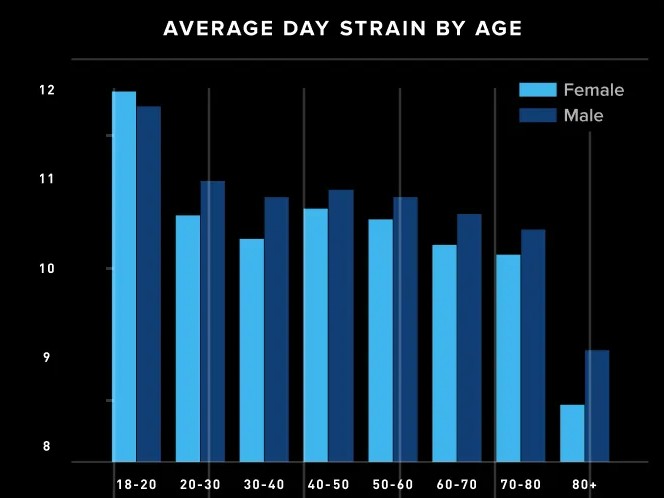
Thus, we encourage each team member to aim a minimum of 11 score in average, while understanding their personal baseline and aim for a daily strain that aligns with their daily recovery, promoting consistent progress without compromising well-being.
The key is to find the balance where you are challenging your body enough to adapt and improve, but not so much that you hinder your recovery or increase your risk of injury.
To help you reach this balance—or to safely intensify your training—you have access directly at Alea to powerful resources: Sauna, Ice Bath, fitness sessions with Udy and Gabi, Hyperbaric Chamber, NeuroVizr, Creatine supplementation, and a proper anti-inflammatory nutrition strategy to support better recovery. The more efficiently you recover, the more energy and resilience you build—making it easier to sustainably reach your optimal Strain range.
2. Biological Age (Healthspan) & Target for ALEA
PACE OF AGING Target for ALEA : < X1 (average, weekly/monthly)
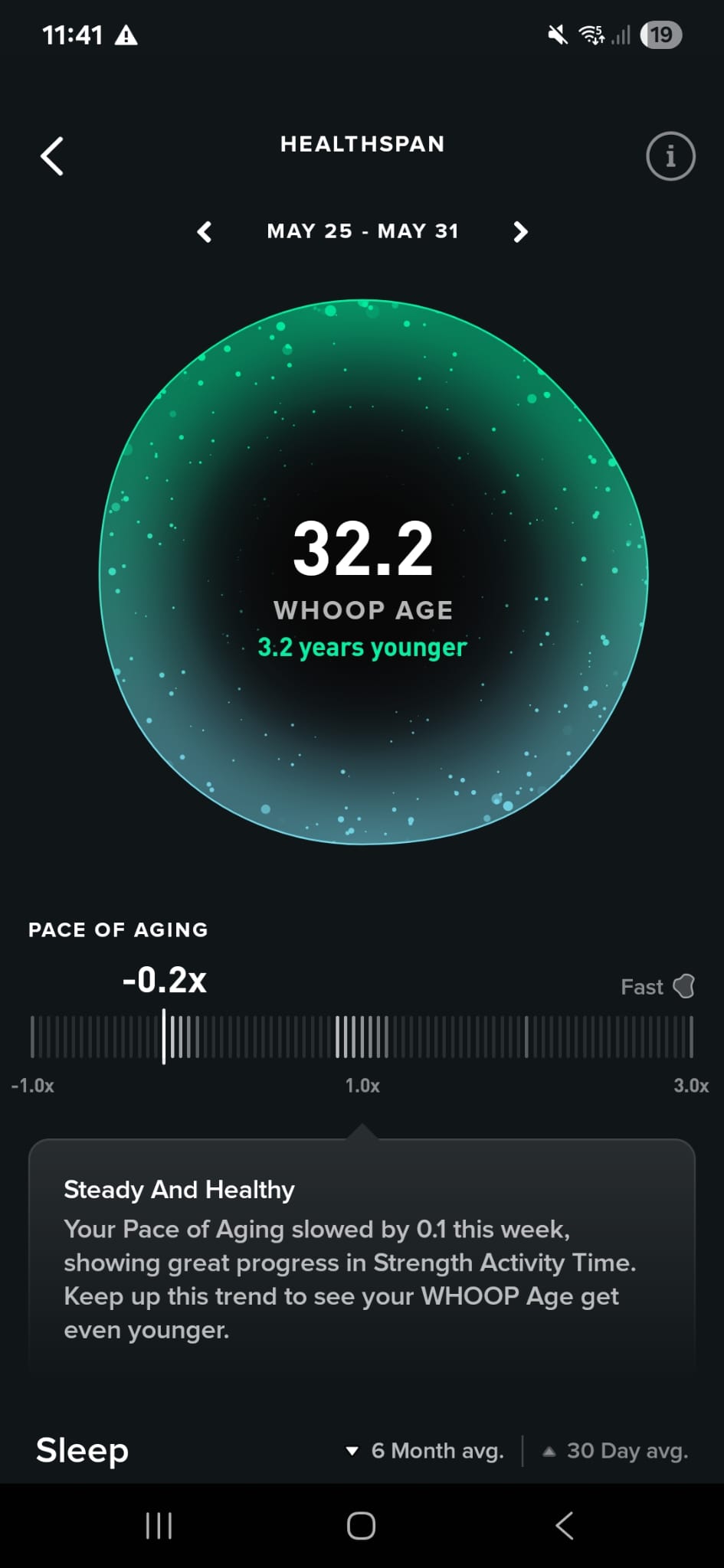
What is Biological Age (Healthspan)?
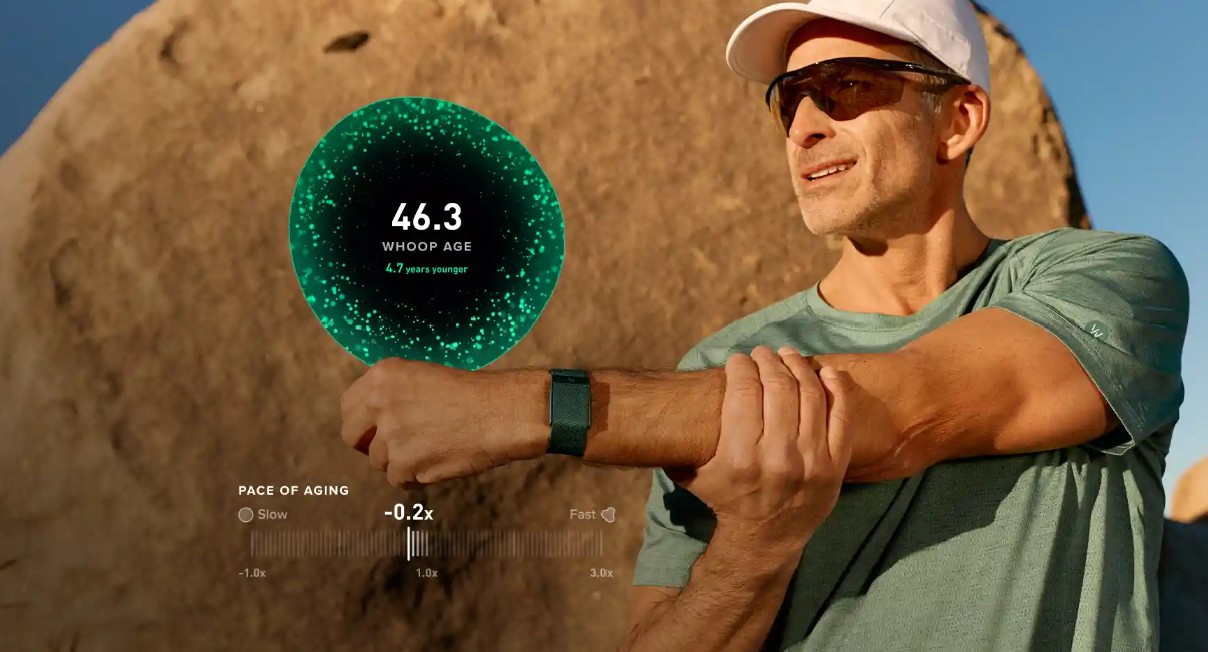
Biological Age, often referred to as Healthspan, represents a way to estimate longevity. Unlike chronological age, which simply counts the years you’ve been alive, Biological Age reflects the true physiological age of your body, based on various biomarkers and health metrics. Therefore, you body can be younger or older than your chronological age, providing a powerful indicator of your overall health and the effectiveness of your lifestyle choices in promoting long-term vitality [2].
WHOOP’s Healthspan feature introduces two critical components to help you understand your biological aging process:
- WHOOP Age: This metric provides a long-term view of your physiological health. It updates gradually over time and offers a comprehensive assessment of how your body is aging based on sustained habits and health trends.
- Pace of Aging: This is a more dynamic metric that reflects how quickly your WHOOP Age is changing. It ranges from -1x to 3x, where a score of -1x indicates that you are effectively decreasing your WHOOP Age (slowing down the aging process), while a score of 3x suggests an accelerated aging process [2]. A score of 1x means you are aging at the same rate as your chronological age.[2]
| Score | Meaning |
|---|---|
| -1x | You are reversing aging – your biological age is decreasing over time. |
| 0x | Your biological age is stable – no detectable aging occurring. |
| 1x | You are aging at the same rate as your chronological age (1 year = 1 biological year). |
| >1x | You are aging faster than expected (e.g., 2x = 2 biological years per real year). |
How is Healthspan Calculated?
WHOOP calculates your Healthspan insights by analyzing nine key metrics across three fundamental pillars of health: sleep, strain, and fitness. These metrics have been selected based on extensive scientific research linking them to longevity and overall well-being. The nine metrics include [2]:
- Sleep Consistency: Regular sleep patterns are crucial for recovery, cognitive function, and disease prevention.
- Total Hours of Sleep: Adequate sleep duration directly impacts your body’s ability to repair and rejuvenate.
- Daily Steps: A fundamental measure of physical activity and overall movement.
- Time in Heart Rate Zones 1-3: Reflects your cardiovascular efficiency during moderate activity.
- Time in Heart Rate Zones 4-5: Indicates your cardiovascular capacity during high-intensity efforts.
- Time Dedicated to Strength-Based Activities: Measures the impact of resistance training on your musculoskeletal system.
- VO₂ Max: A key indicator of cardiovascular fitness and overall aerobic capacity.
- Resting Heart Rate (RHR): A lower RHR generally indicates better cardiovascular health and fitness.
- Lean Body Mass: Reflects muscle mass and body composition, crucial for metabolic health and physical function.
By integrating these diverse data points, Healthspan provides a holistic picture of your long-term health outlook, moving beyond isolated metrics to show how your daily behaviors collectively influence your biological age and your pace of aging. The underlying algorithm is built upon rigorous scientific research, particularly focusing on All-Cause Mortality, a key benchmark in age research that estimates the overall risk of death from any cause within a population【2】.
What makes this feature truly impactful is that WHOOP doesn’t just give you a score—it shows you exactly which metrics are driving it. By seeing in real time how your sleep consistency, VO₂max, training patterns, or even your resting heart rate influence your WHOOP Age, you gain direct visibility into which levers to pull to improve it. Conversely, you also become more aware of how poor habits—like sleep irregularity, inactivity, or chronic stress—can silently accelerate cellular aging. This makes Healthspan not just a diagnostic tool, but a powerful feedback loop for more intentional living.
Why Biological Age (Healthspan) Matters for ALEA
For ALEA members, understanding and actively working to optimize your Biological Age (Healthspan) offers profound benefits:
- Proactive Longevity: Healthspan empowers you to take proactive steps to extend your healthy years, rather than simply adding years to your life. It shifts the focus from treating illness to preventing it and promoting sustained vitality.
- Personalized Insights: By showing how your specific habits impact your biological age, Healthspan provides personalized insights that can guide your lifestyle choices. It helps you identify which behaviors are accelerating or decelerating your aging process.
- Motivation for Healthy Habits: Seeing a tangible metric like WHOOP Age change in response to your efforts can be a powerful motivator. It reinforces the direct link between your daily choices and your long-term health trajectory.
- Enhanced Well-being: A younger Biological Age is associated with increased energy levels, improved cognitive function, greater physical resilience, and a reduced risk of chronic diseases. This translates to a higher quality of life both now and in the future.
- Collective Resilience: As individual ALEA members optimize their Healthspan, it contributes to the overall well-being and resilience of the entire team, fostering a healthier and more productive work environment.
Biological Age (Healthspan) Target for ALEA
At ALEA, our collective goal is to strive for a Biological Age that is consistently younger than our chronological age, and to maintain a Pace of Aging that is at or below 1x (and ideally in the negative range).
This means actively engaging in behaviors that promote cellular health, reduce inflammation, and enhance physiological function.
While specific targets will vary by individual, the overarching aim is to foster habits that contribute to a robust and resilient biological system. This includes prioritizing consistent, quality sleep, engaging in a balanced mix of cardiovascular and strength training, managing stress effectively, and maintaining a healthy body composition.
By focusing on these foundational elements, we can collectively work towards extending our healthspan and enjoying a longer, healthier, and more vibrant life!
HOW TO GET INTO HACKTION?

Practical Instructions
You now have a comprehensive understanding of how the WHOOP Strain Score and Biological Age (Healthspan) provide invaluable insights into your body’s daily demands and long-term vitality. Here’s how to start applying that awareness—today.
1. Strain Score → Optimize Your Daily Load
Check your current Strain and daily Strain target : Regularly review your daily and activity Strain scores in the WHOOP app. Every day the app will guide you, setting an “ideal target” of strain for you.
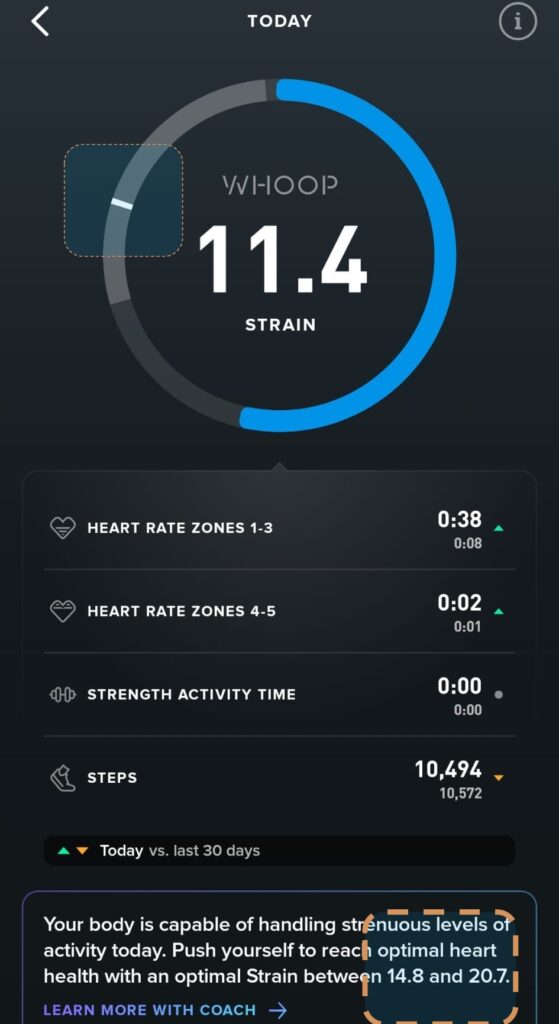
Pay attention to how different activities and stressors impact your overall load. You can also use the “strength trainer” or the activity tracking to increase the accuracy of the strain score. (Also, keeping track of the strenght session will be used to calculate the right “healthspan” scoring.)
- Align with Recovery: Use WHOOP’s Strain Target feature to guide your daily activity. On days with lower Recovery, aim for lighter Strain, and on days with higher Recovery, you can push for greater exertion.
- Choose one consistent action to manage your Strain this week.
For example:
- Integrate active recovery: On days with high Strain, schedule a light walk or gentle stretching to aid recovery and reduce accumulated load.
- Practice stress management: Implement a short mindfulness exercise or deep breathing session during stressful periods of your day to mitigate mental Strain. (Same approach used to raise your HRV)
- Vary your workouts: Alternate between high-intensity and low-intensity workouts to ensure a balanced distribution of Strain throughout the week.
Your only job for now? Become aware of your body’s daily load and make conscious choices to balance exertion with adequate recovery
2. Biological Age (Healthspan) → Invest in Your Future Self (VS being in debt everyday…)
- Monitor your WHOOP Age and Pace of Aging: Regularly check these metrics in the Healthspan section of your WHOOP app. Observe how your lifestyle choices influence these long-term indicators.
- Focus on the Nine Key Metrics: Understand which of the nine metrics (sleep consistency, total sleep hours, daily steps, time in HR zones 1-3, time in HR zones 4-5, strength activities, VO₂ Max, RHR, Lean Body Mass) are most impactful for your Healthspan and prioritize improving those areas.
- Choose one foundational lever to support your Healthspan this week.
- For example:
- Prioritize consistent sleep: Aim for a regular bedtime and wake-up time, even on weekends, to improve sleep consistency and total hours.
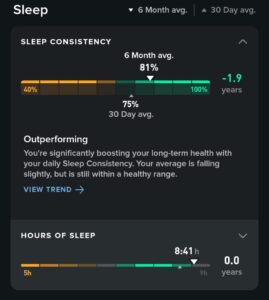
In the following example, we need to : improve sleep consistency and have a better restorative sleep in order to decrease the amount of sleep while having still the good amount of sleep needed. We could then reduce the biological age and the pace of aging accordinlgy.
- Increase Zone 2 cardio: Incorporate more low-intensity, steady-state cardiovascular exercise to improve VO₂ Max and overall heart health.
- Incorporate strength training: Add 2-3 strength training sessions per week to build lean body mass and enhance metabolic health.
Remember:
Small, consistent actions in these areas can lead to significant improvements in your Biological Age over time.
AUTHOR’S NOTE
It’s been a real pleasure to guide you through this 3-part article series—designed to help each person discover their own personal health compass and learn how to use WHOOP’s metrics as more than just numbers on a screen.
The real value lies in understanding the meaning behind the scores, and more importantly, how to gradually improve them. By learning to play with these variables—Strain, Recovery, HRV, VO₂max, Sleep, and Biological Age—we become proactive in our health journey rather than reactive.
And the reward?
More energy. More clarity. More physiological balance.
Because life, at its core, is energy in motion.
When we follow the right feedback loops, we simply live more fully—with less fatigue, fewer symptoms, and more joy in our bodies and minds.
WHOOP is a powerful tool—both individually and collectively—to help us progress in the same direction: toward optimized, resilient health.
I’ll close with this:
If you’ve followed along and internalized what we’ve covered, you should now be able to set personal targets, and at the very least, aim to hit the collective health goals we’ve defined together. And if you’re already ahead—great! Sky’s the limit. That’s what biohacking is all about: mastering your inner feedback loop.
Ultimately, you are the CEO of your own health. WHOOP is your compass. Use it wisely—and keep moving forward.
— Erwin
CONCLUSION (PART 3)
In this final part of our series, we’ve explored the profound insights offered by the WHOOP Strain Score and Biological Age (Healthspan). Understanding your body’s daily physiological load and its true biological age empowers you to make informed decisions that optimize both your immediate performance and your long-term vitality. By actively managing your Strain and investing in habits that improve your Healthspan, you are not just tracking data; you are actively shaping a healthier, more resilient future.
Remember, the journey to optimal health is continuous. Embrace the data as a guide, listen to your body, and consistently apply the principles of balanced exertion and dedicated recovery. The scores will follow, but more importantly, a life of enhanced well-being and extended healthspan awaits.
Erwin
F.A.Q
My Strain Score is consistently high, even on rest days. What does that mean?
A consistently high Strain Score, even without intense physical activity, can indicate significant mental or emotional stress. WHOOP accounts for both physical and mental load. Consider incorporating stress-reducing practices like mindfulness, meditation, or light recovery activities on these days.
Can I really reverse my Biological Age?
While you cannot reverse your chronological age, you can absolutely influence and potentially improve your Biological Age. Consistent healthy habits—including quality sleep, regular exercise (cardio and strength), stress management, and proper nutrition—can lead to a younger WHOOP Age and a slower Pace of Aging.
How often should I check my Healthspan metrics?
Healthspan metrics (WHOOP Age and Pace of Aging) update weekly. While it’s good to monitor them regularly, focus more on the long-term trends rather than daily fluctuations. Consistent healthy behaviors over weeks and months will yield the most significant improvements.
REFERENCES
[1] How Does WHOOP Strain Work? WHOOP. (2023, November 17). Retrieved from https://www.whoop.com/us/en/thelocker/how-does-whoop-strain-work-101/[2] Healthspan: Extend Your Prime for Years to Come. WHOOP. (2025, May 8). Retrieved from https://www.whoop.com/de/en/thelocker/healthspan/