WHOOP as Your Health Compass: Decode Your Scores, Elevate Your Life [Part 2]
TL;DR
Core Concept: This article is the 2nd of a 3-part series designed to decode the WHOOP Core Score Matrix—but more importantly, it lays the foundation for a shared Health Compass at ALEA. While becoming aware of your health scores is already a step forward, understanding how to translate them into individualized goals is what empowers each team member to take autonomous and proactive action. This Compass is not just about metrics—it’s about collective alignment, ownership, and daily movement toward better health and performance.
Significance: We focus on two foundational metrics: VO₂ Max and Recovery Score.
These two scores reveal how your body builds aerobic resilience and adapts to stress. But interpreting them requires context, nuance, and a personal feedback loop. You’ll learn how to track them, understand what actually feeds them, and apply small weekly actions that drive big long-term gains.
Challenges: Recovery isn’t raw power. And VO₂ Max isn’t just for athletes.
Both scores are shaped by invisible systems—sleep, stress, nervous system flexibility—and WHOOP tracks these in a relative, individual way. That’s why we move away from universal benchmarks and toward personalized targets, based on your own best averages.
Strong Fact: A VO₂ max in the “GOOD” zone is associated with up to 64% reduction in all-cause mortality risk, according to population-level studies.
At ALEA, this is our collective benchmark—not because we aim to become elite athletes, but because we believe in building long-term physiological resilience.
OVERVIEW
You’ve all had the opportunity—and the privilege—of receiving a WHOOP device: one of the most advanced personal health trackers available today.
With this tool, you can measure critical indicators of your recovery, stress, sleep quality, cardiovascular performance, and even your rate of aging. That’s the promise of WHOOP: turning invisible health dynamics into clear, actionable feedback.
But this article isn’t about promoting the device—it’s about showing you how to make sense of the scores it gives you. We’ll explore how, with just a few key metrics, you can steer your health, performance, and wellbeing in the right direction—day after day, and month after month.
In short: you already have the tool. Now let’s unlock its full potential.

🧭 The 6 Core WHOOP Metrics You Should Track
These six scores are the foundation of the WHOOP system and offer powerful insights into your physical and mental health (in the order of importance):
| Score | What It Measures | Why It Matters |
|---|---|---|
| 1. Sleep Score | Sleep duration & quality | Foundational for recovery, immunity, hormone balance, and cognition |
| 2. HRV (Heart Rate Variability) | Nervous system flexibility | Reflects stress resilience and readiness to perform |
| 3. VO₂max | Max aerobic capacity | Key predictor of longevity, cardiovascular health, cognitive function |
| 4. Recovery Score | Daily readiness index [Aggregated Score] | Integrates HRV, sleep, strain into one actionable score |
| 5. Strain Score | Daily cardiovascular & muscular load | Helps optimize training and avoid burnout or underuse |
| 6. Biological Age (Healthspan) (New Peak Feature) | Rate of aging based on key biomarkers. [Aggregated Score] | Compares your physiological age to your real age, tracks how daily habits accelerate or slow down aging. |
1. VO2 Max score & Score Target for Alea
VO2 max Score Target for ALEA :
Everybody should aim to reach or maintain the GOOD zone based on their age and sex. (see table below)
Why it matters:
VO₂ max is one of the most powerful predictors of longevity, cardiovascular health, and physical resilience. It reflects your body’s capacity to deliver and use oxygen during effort—your aerobic engine.
A low VO₂ max has been directly linked to higher all-cause mortality than common chronic conditions like type 2 diabetes.
Thus, VO₂ max is not only a performance metric—it’s a healthspan indicator.
Relevance of VO₂ Max in WHOOP:
WHOOP estimates VO₂ max using heart rate data from logged runs and activities. While not as precise as lab testing, it’s consistent enough to track trends and individual improvements when logged with GPS.
VO₂ Max Performance Zones :
First, let’s consider the general insights from studies (and previous article [1] – https://health.alea.com/vo2-max-your-bodys-dyno-test/)
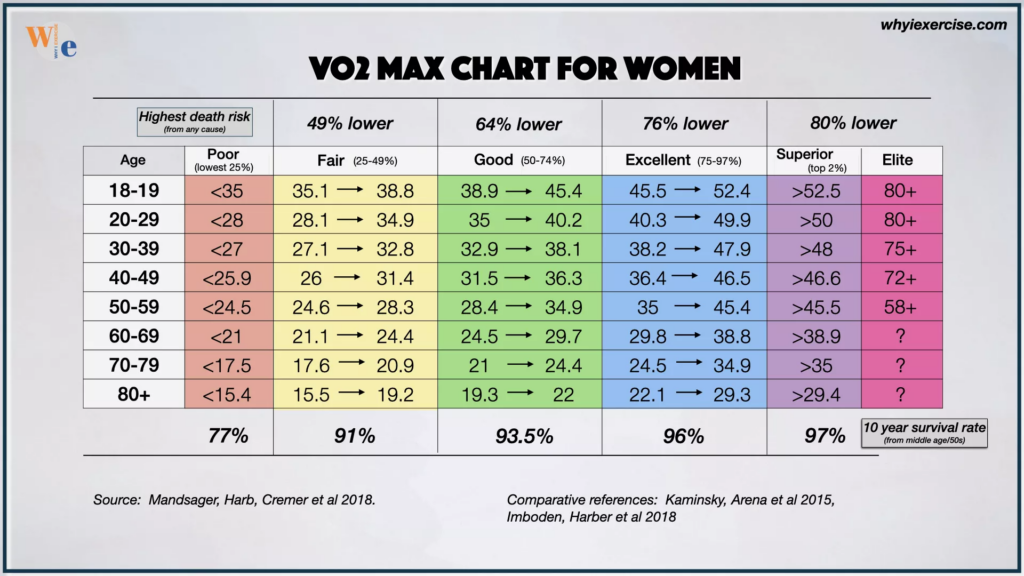
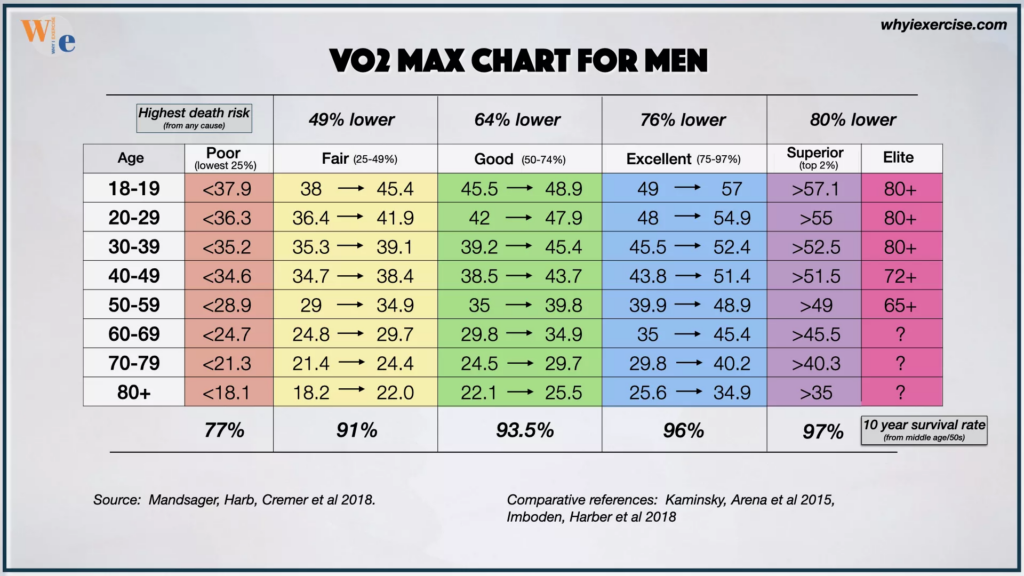
(Source: https://www.whyiexercise.com/VO2-Max.html)
Score target for Alea :
At ALEA, we don’t just aim for the bare minimum.
We strive for sustainable metabolic efficiency, optimal functional capacity, and a significant reduction in mortality risk.
Therefore, the GOOD zone seems to be an achievable and realistic goal. An objective that is already associated with a notably extended lifespan—without requiring elite-level athleticism.
This range is associated with a 64% reduction in all-cause mortality risk compared to the lowest quartile.
| Age Range | Target VO₂ Max – Men (ml/kg/min) “GOOD ZONE” | Target VO₂ Max – Women (ml/kg/min) “GOOD ZONE” |
|---|---|---|
| 20–29 | 42.0 → 47.9 | 35.0 → 40.2 |
| 30–39 | 39.2 → 45.4 | 32.9 → 38.1 |
| 40–49 | 38.5 → 43.6 | 31.5 → 36.3 |
| 50–59 | 35.0 → 39.8 | 28.4 → 34.8 |
2. RECOVERY SCORE
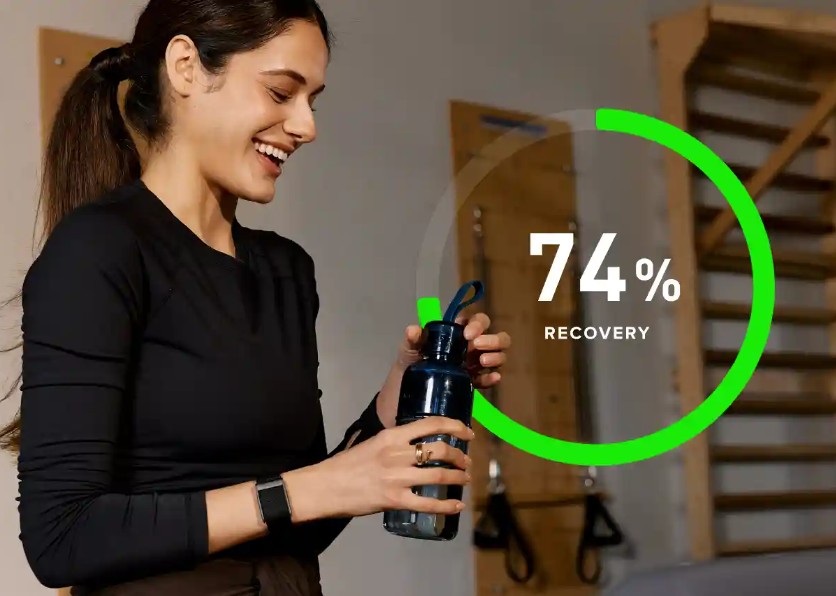
RECOVERY Target for ALEA : ≥ 67% (green zone average, weekly/monthly)
Why it matters:
The WHOOP Recovery Score is often presented as the most “actionable” daily health metric—an instant signal of how ready your body is to perform, adapt, and take on physical or mental strain.
We could also say that it is a reflection of your ability to keep your nervous system resilient.
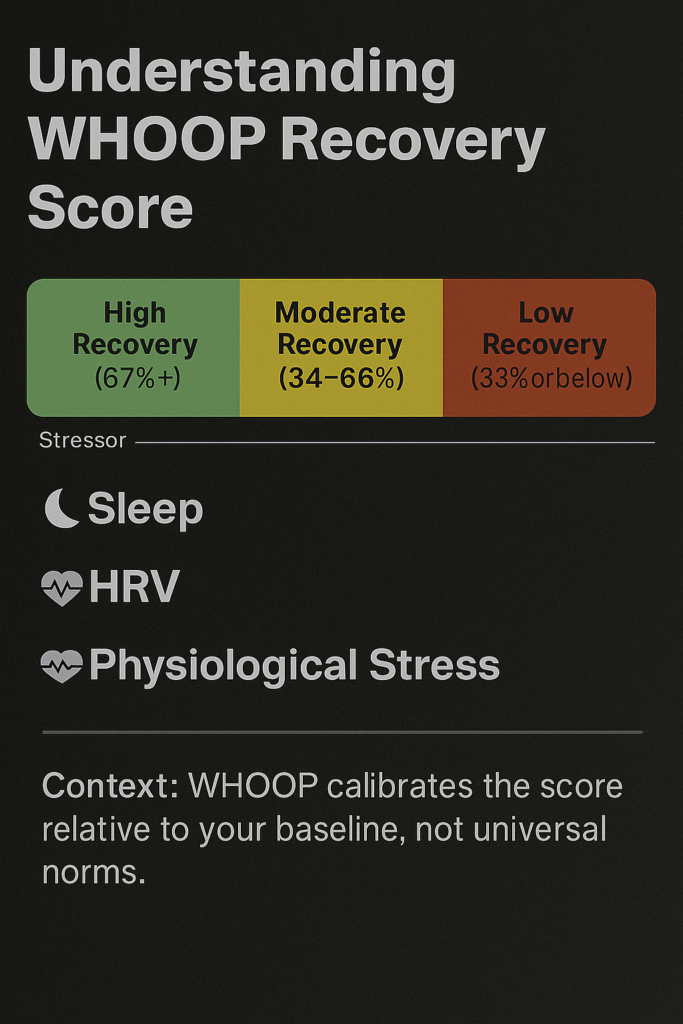
And that’s because it aggregates what really matters: your sleep, your HRV, and your physiological stress levels (via respiratory rate, skin temperature and RHR).
When these elements are aligned, your recovery score rises.
When one breaks down—especially sleep—your recovery score usually crashes.
As a reminder (from whoop) :
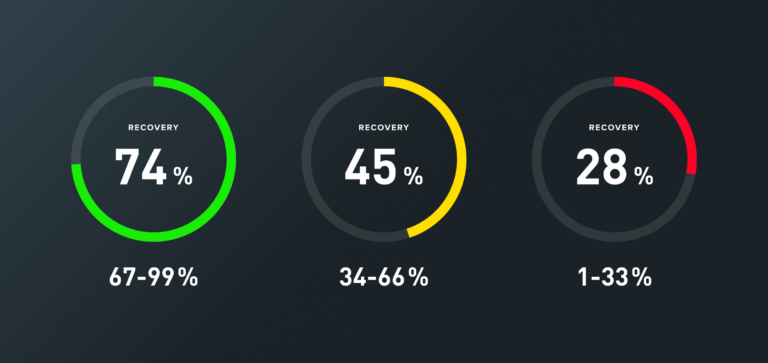
- High Recovery (Green, 67% or above) → Your body is primed to adapt to a higher training load.
- Moderate Recovery (Yellow, 34-66%) → Your body is maintaining its baseline zones, but may be more susceptible to fatigue or stress.
- Low Recovery (Red, 33% or below) → Your body may be under increased stress, and you should consider adjusting Strain or prioritizing recovery activities.
Relevance of WHOOP’s RECOVERY Score:
Recovery Score is like a readout of how well your nervous system and recovery environment responded to your previous day’s inputs.
From experience and whoop explanation, it’s clear that:
- HRV is the heaviest weight in the algorithm and therefore plays a strong underlying role. When HRV drops (even slightly), Recovery follows.
- Sleep has also a lot of weight in the algorithm. Miss your sleep need, and your Recovery tanks—even if everything else looks fine.
- VO₂ max matters indirectly: a stronger aerobic system (higher VO₂ max) leads to a lower resting heart rate and faster recovery kinetics—which improve your HRV baseline and thus Recovery Score over time.
- Sudden spikes in skin temperature or respiratory rate may also drop your score—often tied to alcohol, stress, illness, heavy meals, or poor sleep hygiene (e.g., overheating at night).
And yes, some days, your Recovery Score can go down even if your routine is perfect—because WHOOP’s algorithm is relational, not absolute. It tracks variations relative to your recent personal baseline.
That’s why it can feel frustrating: doing everything “right” but still waking up with a red or yellow score…
Score target for Alea : Focus on What Feeds the Score
At ALEA, we want to build the underlying systems that drive a high Recovery Score:
- 🌙 Sleep: Prioritizing deep, consistent, restorative rest
- 💓 HRV: Cultivating nervous system adaptability through breathwork, hydration, and circadian alignment
- 🫁 VO₂ Max: Improving aerobic capacity through structured training (Zone 2 + HIIT)
These are the real levers. And when they improve over time, the Recovery Score naturally trends upward.
That said, the good reflection of putting in practice a good routine should lead you to score on average higher than 67%. (Green Zone)
Some additional thoughts on “recovery score” :
WHOOP calibrates the score relative to your own baselines, not against global norms.
This means two users with identical raw data (HRV, RHR, sleep) could receive different Recovery Scores depending on their personal averages.
👉 So while the color scale may appear standardized, the meaning of “80% Recovery” is fundamentally contextual and individual.
Example : Two Recovery Profiles — and Why Only One Reflects Progress
It’s important to distinguish between two profiles:
- Stable Recovery (green zone) with no change in HRV, sleep, or VO₂ max
→ reflects consistent habits, but limited physiological progress - Trending Recovery (green + improving inputs)
→ reflects meaningful nervous system evolution and improved long-term resilience
Only the second reflects a better healthspan optimization.
Also, just because someone shows a higher Recovery Score doesn’t mean they can physically or mentally perform better than someone else.
It simply means their autonomic nervous system is better balanced compared to their personal baseline, that day.
Recovery reflects ability to balance your nervous system and readiness. Not raw power.
That’s why the score shouldn’t be used too much to compare between individuals, but rather to track intra-individual fluctuations and support decisions on training, load, or rest.
And this is why I suggest to keep track on Sleep Score, HRV, VO2 max first. Which mecanically would drive the ability to score higher in Recovery.
HOW TO GET INTO HACKTION?

Practical Instructions
You’ve now got a clearer understanding of why VO2 max Score and Recovery matter. Here’s how to start applying that awareness—today.
1. VO 2 MAX Score → Build Your Aerobic Engine
- 📍 Check your current VO₂ max estimate on WHOOP (Strain → VO₂ Max).
- 🎯Compare it to the “GOOD zone” for your age and sex (see reference table above).
Not there yet? That’s OK—set your target accordingly. This is about training for healthspan, not performance. - ✏️ Choose one consistent aerobic action to take this week. For example:
👉 Schedule 2 x 45-minute Zone 2 cardio sessions (easy run, cycling, incline walk).
Your only job for now? Create space in your calendar for that low-intensity, high-impact time with your breath and your body.
REMEMBER : You can follow the exact VO2 max training protocol HERE.
2. Recovery Score → Track the Trend, Not the Number
- 📍 Check your average Recovery Score for the past week. Is it generally in the green zone (≥ 67%)?
- 🎯 Don’t chase spikes. Instead, aim for stability and slow upward trends over time.
- ✏️ Choose one foundational lever to support your recovery ecosystem this week. For example:
👉 Do a 5-minute coherence breathing session before bed to activate the parasympathetic system and increase your HRV.
👉 Eat your last meal at least 4 hours before bed.
This supports digestion, improves sleep depth, and helps raise your HRV—which feeds into your Recovery Score.
Remember:
Recovery Score reflects your ability to balance—not your raw strength.
The more you support sleep, HRV, and VO₂ max, the more your recovery will follow—naturally.
AUTHOR’S NOTE
As we wrap up this 2nd part, I’d like to leave you with two important reflections that NEEDS to be REPEATED.
1. Let’s keep this fun and human.
The WHOOP Score Matrix is a powerful tool—but at its core, it’s designed to gamify your health journey, not to add pressure or guilt. The idea is to give you a clear, personal direction—a North Star—that feels realistic, aligned with human biology, and grounded in credible data.
Your goal should not be perfection. Your goal is awareness. And from that awareness, set a personal benchmark that feels motivating. The timeframe and path to get there? Entirely yours.
This is about feeling better, having more energy, and enjoying your body and mind in better alignment. That’s it.
2. Trackers aren’t perfect—don’t obsess over the numbers.
Even the best wearables have limits. WHOOP is incredibly sophisticated, but it’s not infallible. The scores you see aren’t absolute truths—they’re indicators. Use them to build awareness, not anxiety.
Don’t get stuck on a single night’s score or a bad HRV day. Zoom out. Reflect. Adjust. Move forward.
This is a journey of conscious self-regulation, not digital obedience. Use the data as a mirror—not a judge.
In the end, the only score that truly matters is the one you feel—when you wake up rested, move with ease, and live with clarity.
Stay curious. Stay kind to your process.
CONCLUSION (PART 2)
In this second part, we focused on two key metrics: VO₂ Max and Recovery Score.
Here’s the simple truth: You don’t need to be an athlete and you should pay to your nervous system balance.
Improving your aerobic fitness (VO₂ Max) and keeping your nervous system balanced (Recovery) will make you more resilient, more clear-headed, and more capable — day after day.
Sleep well. Move often. Recover fully. The scores will follow.
Erwin
F.A.Q
My Recovery Score is low even though I slept 8 hours. What’s going on?
Recovery is not just about sleep quantity. HRV, sleep quality, timing, stress, alcohol, late meals, and even emotional load all matter. One good night can’t fix everything — aim for consistency over time.
HRV reflects how well your body responds to that recovery—your resilience.
Ideally, aim for high performance on both, but if one is off, start by fixing your sleep.
Sleep Score reflects how much and how well you sleep—your base of recovery.
Should I train hard on a red Recovery day?
⚠️ Not ideal. Red doesn’t mean you’re broken — but your body is under stress. If you train, go light. Or shift the focus to mobility, breathwork, or active recovery.
Someone else has a much higher Recovery Score than me. Should I be worried?
No. WHOOP scores are personalized to your own baseline. The number only makes sense in the context of your trends — not someone else’s.
REFERENCES
[1] https://health.alea.com/vo2-max-your-bodys-dyno-test/